How to use a pipette – 10 tips
Written by Emir Cetojevic · 19. February 2021
It is not just the specifications, calibration, repair and maintenance of pipettes that influence their accuracy, but also the user. Even the most accurate and precise instruments on the market can produce poor results if you don't follow pipetting best practices. This article guides you through 10 tips that will enable you to use your pipette correctly to immediately improve your results:
- Ensure temperature equilibrium: Make sure the pipette, tips and liquids are at room temperature (if experiment allows)
- Maintain consistent pipette angle: Hold the pipette at a consistent angle not exceeding 20 degrees
- How to aspirate: Aspirate by immersing the tips just below the liquid’s surface (2-3 mm)
- Touch off after dispense: Touch off after each dispense when removing the pipette from the target vessel
- Pre-wet: Pre-wet by aspirating and dispensing the nominal volume 3 times
- Optimize the volume range: Pipette within the optimal volume range (35-100 % of the nominal volume for air displacement pipettes)
- Discard first and last dispense: When dispensing multiple aliquots, it is recommended to discard the first and last dispense of the series
- Pipetting viscous liquids: Pipette viscous liquids at slower speeds and in "Reverse pipet" mode
- Pipetting volatile liquids: Pipette volatile liquids quickly and in "Reverse pipet" mode
- Calibrate based on liquid density: Recalibrate your pipette if the liquid has a considerably different density than water
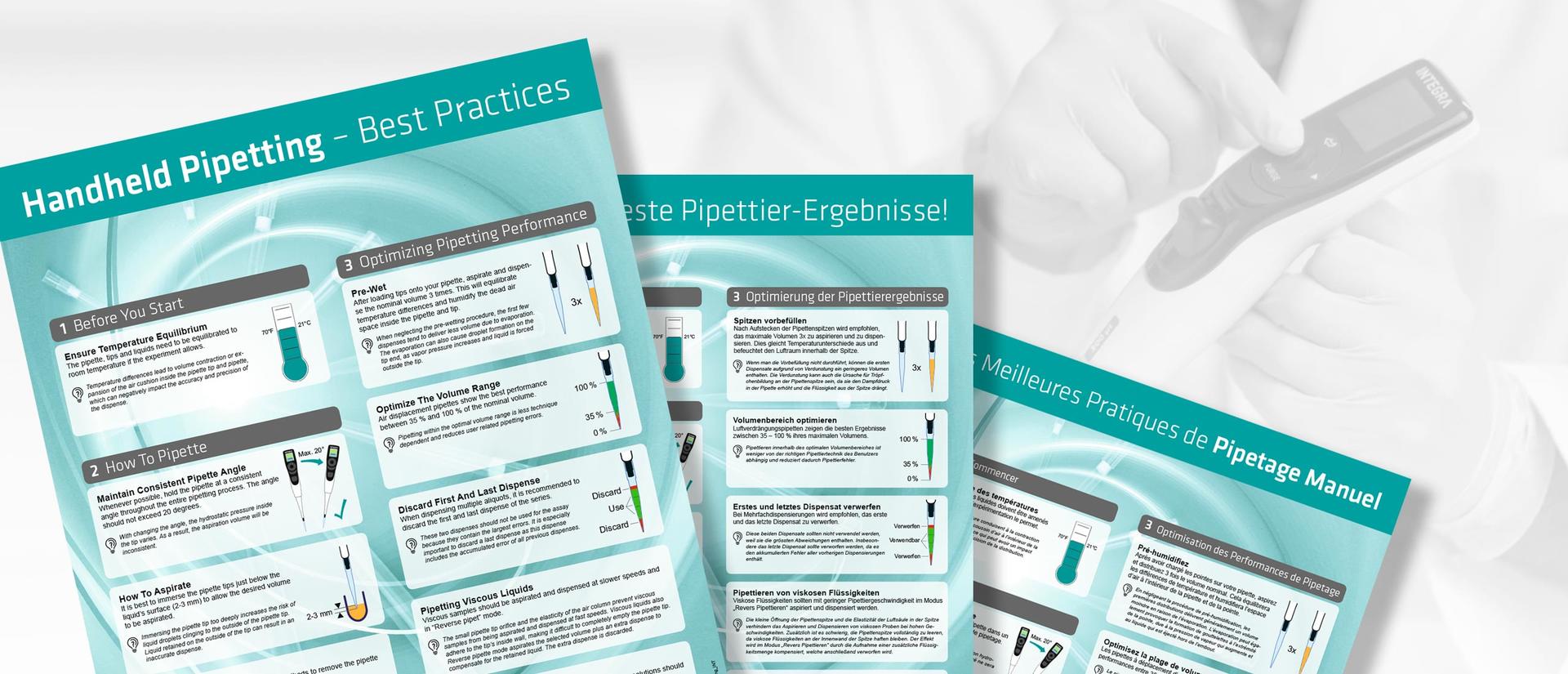
If you wish, you can also download the tips as a poster or check out our video series on best pipetting practices.
Table of contents
Before you start
1. Ensure temperature equilibrium
The pipette, tips and liquids need to be equilibrated to room temperature if the experiment allows.
Note: Temperature differences lead to volume contraction or expansion of the air cushion inside the pipette tip and pipette, which can negatively impact the accuracy and precision of the dispense.

How to pipette
2. Maintain consistent pipette angle
Whenever possible, hold the pipette at a consistent angle throughout the entire pipetting process. The angle should not exceed 20 degrees.
Note: With changing the angle, the hydrostatic pressure inside the tip varies. As a result, the aspiration volume will be inconsistent.

3. How to aspirate
It is best to immerse the pipette tips just below the liquid’s surface (2-3 mm) to allow the desired volume to be aspirated. Immersing the pipette tip too deeply increases the risk of liquid droplets clinging to the outside of the pipette tip.
Note: Liquid retained on the outside of the tip can result in an inaccurate dispense.

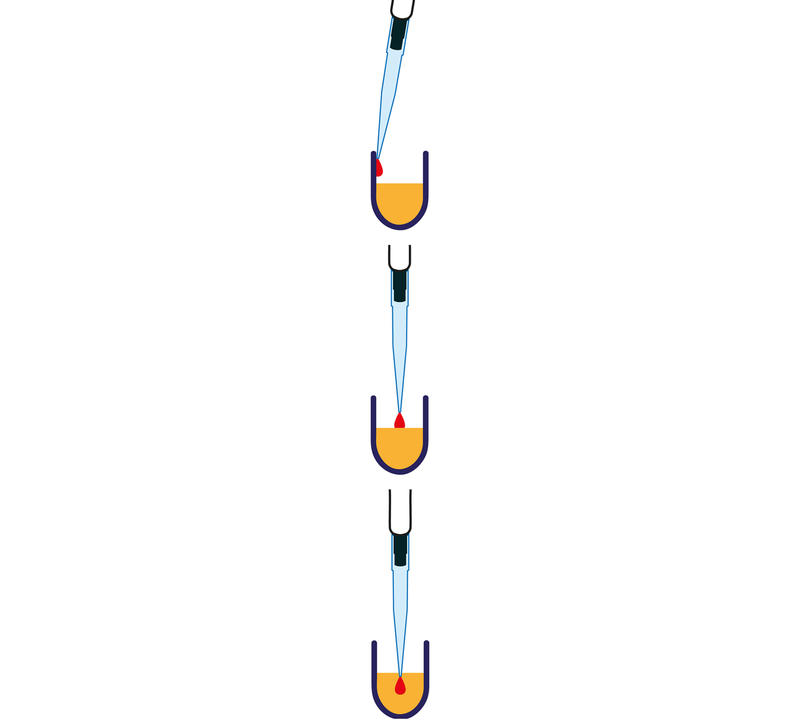
4. Touch off after dispense
After a dispense, use one of the following 3 methods to remove the pipette from the target vessel.
- Side wall touch off
(Standard Method)
Remove the pipette tip by sliding the tip end along the sidewall of the vessel. Recommended to achieve the most accurate dispense. - Surface touch off
Remove the tip by touching off the liquid droplet on the surface of the liquid in the container. Recommended when dispensing less than 1µL as a neat transfer. Touching the droplet to the liquid draws the small droplet out of the pipette tip which ensures accurate delivery. - Into liquid dispense
If the dispense was made directly into the liquid, it is considered a wet-dispense and a touch off is not required. Ideal for small volume dispensing to ensure the liquid does not remain on the side of the vessel.
Note: After a dispense, residual liquid often clings to the tip end. The above techniques remove this residual liquid from the tip.
Optimizing pipetting performance
5. Pre-wet
After loading tips onto your pipette, aspirate and dispense the nominal volume 3 times. This will equilibrate temperature differences and humidify the dead air space inside the pipette and tip. When neglecting the pre-wetting procedure, the first few dispenses tend to deliver less volume due to evaporation.
Note: The evaporation can also cause droplet formation on the tip end, as vapor pressure increases and liquid is forced outside the tip.

6. Optimize the volume range
Air displacement pipettes show the best performance between 35 % and 100 % of the nominal volume. On top of that, pipetting within the optimal volume range is less technique dependent and reduces user related pipetting errors.

7. Discard first and last dispense
When dispensing multiple aliquots, it is recommended to discard the first and last dispense of the series.
Note: These two dispenses should not be used for the assay because they contain the largest errors. It is especially important to discard a last dispense as this dispense includes the accumulated error of all previous dispenses.

8. Pipetting viscous liquids
Viscous samples should be aspirated and dispensed at slower speeds because of the small pipette orifice and the elasticity of the air column. As they also adhere to the tip’s inside wall, you need to use the “Reverse pipet” mode to compensate for the retained liquid.
Note: "Reverse pipet" mode aspirates the selected volume plus an extra dispense. The extra dispense is discarded.
9. Pipetting volatile liquids
Pre-wet pipette tips to humidify the dead air space. Volatile solutions should be pipetted quickly and in “Reverse pipet” mode. The "Reverse pipet" mode incorporates a larger sample volume to minimize the effect of evaporation on the actual volume to be delivered.
10. Calibrate based on liquid density
Significant pipetting errors can occur when liquids other than aqueous solutions are used. Recalibrate your pipette if the liquid has a considerably different density than water.
Note: Pipettes are normally tested and calibrated at the factory with distilled water at room temperature. Pipetting liquids with different densities results in inaccurate dispenses.
Conclusion
If you've already integrated these tips into your daily routine, you're officially a pipetting pro. And if not, you can become one by downloading the tips as a poster that will constantly remind you of best practices, until they become subconscious routine.
Further reading:
Ask our expert. Leave a comment!
Write us if you have any questions regarding the blog article.
About the author