RNA interference: silencing genes to advance science and medicine
Written by Anina Werner · 10. June 2026
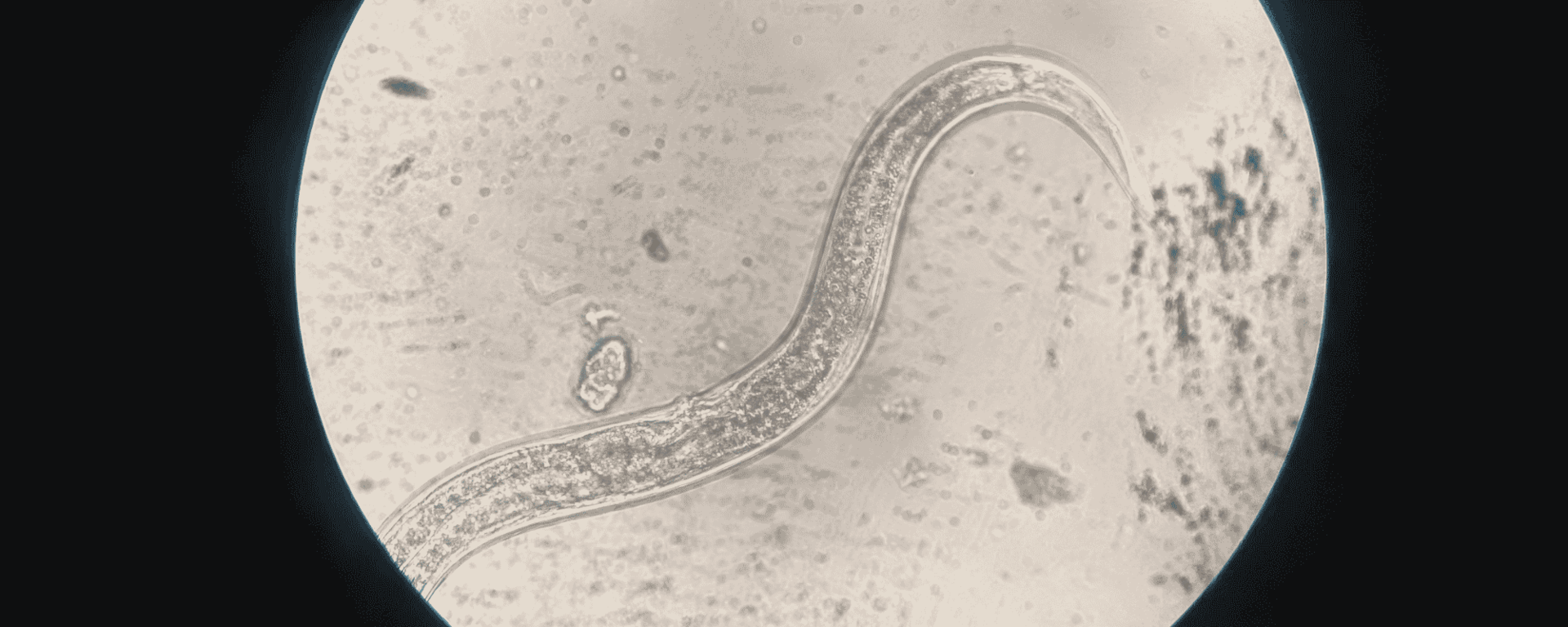
In 1998, Andrew Fire and Craig Mello published a deceptively simple observation: injecting double-stranded RNA (dsRNA) into the nematode worm Caenorhabditis elegans could silence a matching gene. The phenomenon, which they called RNA interference (RNAi), earned them the 2006 Nobel Prize in Physiology or Medicine and fundamentally changed how scientists think about gene regulation.
What Fire and Mello discovered is a conserved, natural cellular mechanism found in nearly all eukaryotes, from fungi and plants to animals and humans. Cells use it to fight viruses, fine-tune the expression of their own genes, and control jumping genes called transposons. Scientists have since harnessed this machinery to knock down genes of interest, opening new avenues in functional genomics and therapeutics.
This article explains how the RNAi pathway works, compares the 2 small RNA effectors – siRNA and miRNA – and provides an overview of the landscape of RNAi laboratory applications and therapeutics.
Table of contents
What is RNAi?
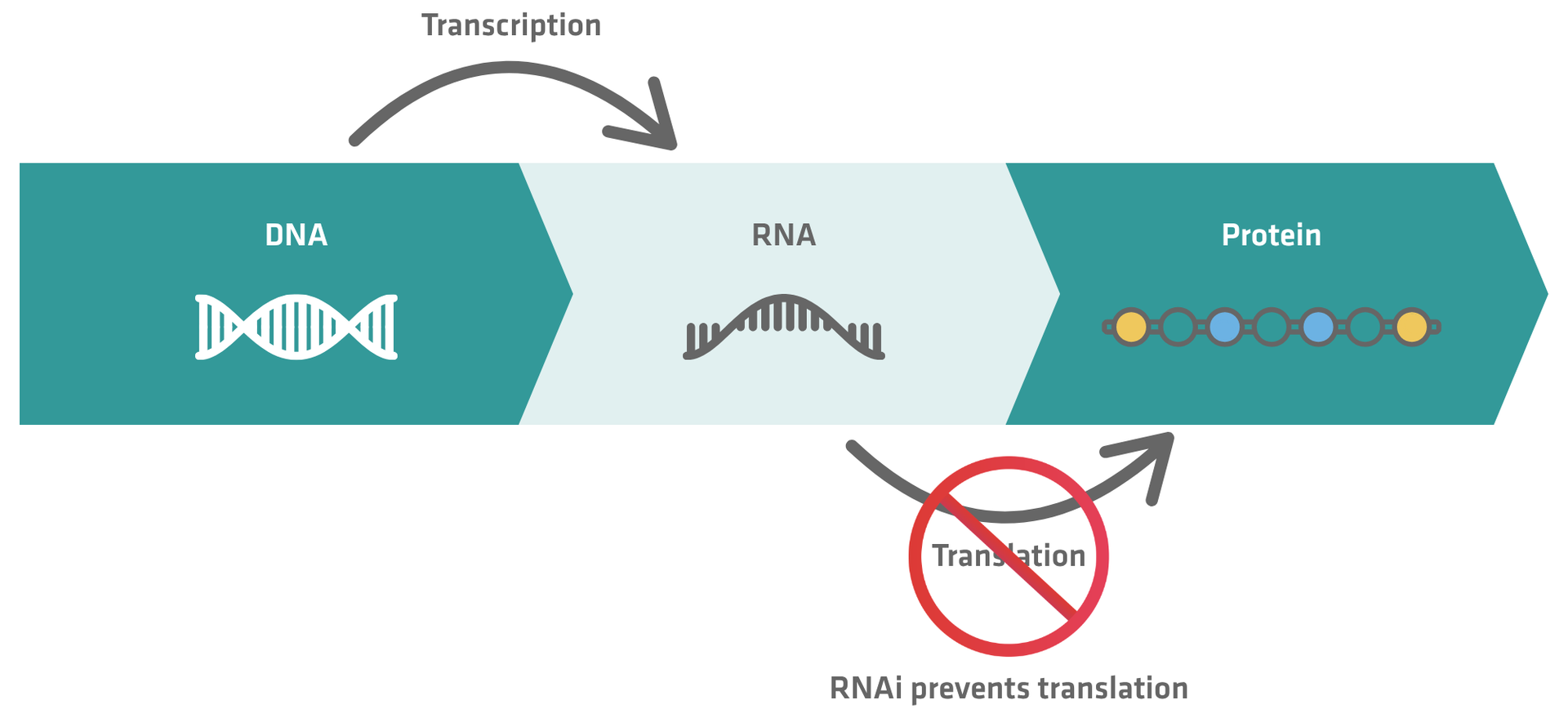
Proteins are the building blocks of life, and the 2-step biosynthesis process is the same for all eukaryotes:
- Transcription: genes encoded in the DNA are transcribed into messenger RNA (mRNA) molecules within the cell nucleus.
- Translation: the mRNA molecules travel to the cytoplasm where they are translated into proteins.
RNAi is a post-transcriptional gene-silencing mechanism that allows cells to switch off specific genes after their mRNA has been transcribed, but before it is translated into proteins.
Beyond fine-tuning normal gene expression, RNAi also serves as a defense system against viruses by degrading viral RNA before it can hijack the host cell’s machinery, and against transposons by destroying their mRNA transcripts before they produce proteins required for their movement. RNAi is only 1 of several mechanisms that keep transposons in check; to learn more about transposons and additional cellular defense strategies, see our article Transposons: the ‘jumping genes’ revolutionizing genetics.
How does RNAi work?
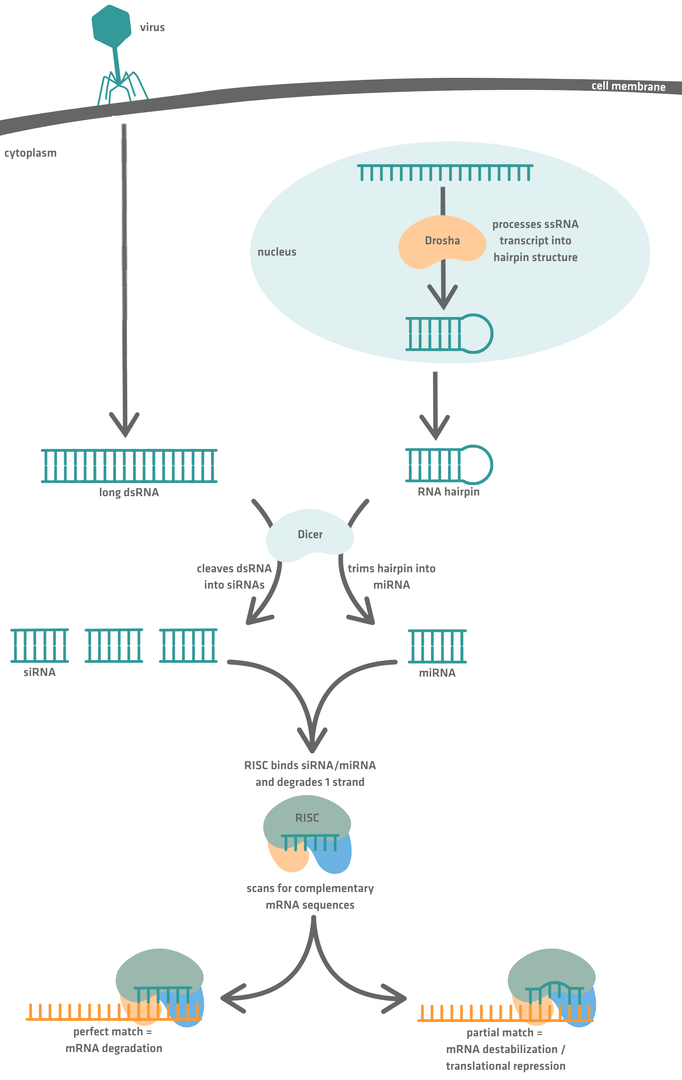
The RNAi mechanism can be divided into 3 main stages: initiation, RISC assembly and silencing.
Step 1: initiation
The RNAi pathway is initiated by long dsRNA or RNA hairpin molecules that are recognized and processed by an enzyme called Dicer. These triggering RNA molecules can originate outside the cell (exogenous) or be produced within the cell (endogenous). An example of an exogenous trigger is long dsRNA injected by a virus. This viral RNA is cleaved by Dicer into short fragments known as small interfering RNAs (siRNAs). Endogenous triggers often arise from non-coding single-stranded RNA (ssRNA) transcripts that are processed into a hairpin structure within the nucleus by an enzyme called Drosha. When transferred to the cytoplasm, Dicer trims these hairpins into short RNA duplexes called microRNAs (miRNAs).
Step 2: RISC assembly
siRNAs and miRNAs are recognized by a protein complex called the RNA-induced silencing complex (RISC). RISC is loaded with a short siRNA- or miRNA-duplex, after which 1 strand – the passenger strand – is discarded, and the remaining strand – the guide strand – directs RISC to complementary target mRNA sequences.
Step 3: target recognition and silencing
Target mRNA sequences can either be perfectly or partially complementary to the remaining RNA strand of RISC.
- If complementarity is perfect (typical of siRNA-mediated silencing), the matching target sequence is cleaved into fragments, ensuring that it is degraded instead of translated into proteins.
- If complementarity is partial (typical of miRNA-mediated silencing), RISC recruits additional proteins that destabilize the mRNA (promoting its decay) or block the ribosomes from translating it into proteins.
In both cases, a single RISC complex can act catalytically, moving from an mRNA target to the next, so a small amount of siRNA or miRNA molecules can produce a strong silencing effect.
siRNA vs miRNA
siRNAs and miRNAs are both 'small RNAs', a broad term used to describe non-coding RNA molecules shorter than 200 nucleotides. siRNAs and miRNAs differ in their origin, production process and mRNA targeting, and have distinct biological roles and applications.
siRNAs can have various exogenous and endogenous origins. Here are some examples:
- Viral: exogenous dsRNA from a virus can be transformed into siRNAs by the host cell to detect, target and destroy the genetic material of invading pathogens.
- Synthetically produced: another common exogenous source is synthetically produced siRNAs that are leveraged by scientists to perform gene knockdown studies in basic research and drug development.
- Transposons: endogenous siRNAs from transposons allow cells to degrade mRNA transcripts from these jumping genes, preventing them from moving from 1 location to another within the genome.
- Pseudogene-gene pairs (PGG pairs): PGG pairs consist of a functional protein-coding gene and its corresponding pseudogene, a non-functional DNA segment sharing a high degree of sequence similarity. These pseudogenes can be transcribed and broken down into siRNAs that target and regulate the expression of the functional counterpart.
All siRNAs have a long dsRNA precursor structure and usually show perfect or near-perfect complementarity to 1 target mRNA sequence, resulting in the cleavage and degradation of a specific transcript.
On the other hand, miRNAs are typically endogenous and produced from a hairpin-shaped structure. This hairpin-shaped pre-miRNA molecule is usually created from an ssRNA transcript within the nucleus by Drosha. An exception is Drosha-independent miRNAs, e.g. mirtrons. Mirtrons can form when functional, mature mRNAs are created within the nucleus. To form these mRNAs, non-coding sections – introns – are removed from the pre-mRNA molecule, and coding sections – exons – are joined together. Some of these spliced out introns can fold into a hairpin-shaped structure that is subsequently processed into a miRNA molecule in the cytoplasm by Dicer.
Another shared characteristic of miRNAs is that they are normally only partially complementary to their target mRNA sequence, resulting in its destabilization or translational repression. This imperfect complementarity means that a single miRNA molecule can target many different mRNA molecules, making it a regulatory switch rather than a precision knockdown tool. miRNAs play crucial roles in:
- Proliferation and apoptosis, by pushing a cell to divide or to die by turning down the levels of cell-cycle or cell-death proteins.
- Differentiation, by repressing pluripotency genes to push embryonic stem cells toward a differentiated state.
- Homeostasis, by fine-tuning protein expression of many signaling and metabolic genes to keep key pathways within a healthy range and maintain stability over time.
In addition, miRNA molecules are used as disease biomarkers in research and diagnostic applications. Dysregulation of miRNA networks has been associated with cancer, cardiovascular diseases, neurological disorders and many other conditions.
| siRNA | miRNA | |
| Full name | Small interfering RNA | microRNA |
| Origin | Exogenous (e.g. viral, synthetic) or endogenous (e.g. transposons, PGG pairs) | Typically endogenous |
| Precursor structure | Long dsRNA | Hairpin-shaped pre-miRNA |
| Nuclear processing | No – bypasses Drosha entirely | Usually yes – Drosha forms pre-miRNA in the nucleus; except Drosha-independent miRNAs (e.g. mirtrons) |
| Base pairing with target | Perfect or near-perfect complementarity | Partial or imperfect complementarity |
| Number of targets | Typically 1 specific mRNA target | Multiple genes regulated by 1 miRNA |
| Main biological functions | mRNA cleavage of target sequence to fight RNA viruses, silence transposons, regulate gene expression | mRNA degradation or translational repression of target sequences to fine-tune gene expression networks |
| Research and therapeutic applications | Gene knockdown studies, drug development | Disease biomarkers |
RNAi in the laboratory: research applications
RNAi allows researchers to perform controlled gene knockdown screens and miRNA modulation experiments. Carrying out these studies in cell culture and model organisms helps to identify genes and miRNA-mediated pathways involved in specific biological processes, disease phenotypes or drug responses. The tools available for these loss- and gain-of-function studies are siRNA transfection, short hairpin RNA (shRNA) transgenesis, and miRNA mimics and inhibitors.
siRNA transfection
The most widely used approach for gene knockdown experiments involves synthesizing siRNAs with a sequence complementary to the target mRNA and introducing them into cells by transfection for loss-of-function studies. Because siRNAs are short and chemically defined, they can be designed and synthesized rapidly. However, the silencing effect is transient; siRNAs are diluted as cells divide and are eventually degraded, making them suitable for short-term knockdown experiments.
shRNA transgenesis
Transgenesis is the process of introducing an exogenous gene – called a transgene – from an organism into the genome of another, allowing the recipient to exhibit new properties and pass them to its offspring. shRNA transgenesis is used for stable, long-term gene silencing and requires researchers to encode shRNAs in viral or plasmid vectors. These vectors integrate into the host genome where they are transcribed. Once transcribed, the shRNA transcript folds into a hairpin structure that mimics a pre-miRNA, which is then cleaved by Dicer in the cytoplasm into a siRNA-like duplex. This duplex is then loaded into RISC, where the guide strand directs sequence-specific mRNA silencing. Because the shRNA-encoding construct is stably integrated, knockdown persists through cell division, making shRNA particularly suited to long-term studies, in vivo models and viral delivery into hard-to-transfect cell types. shRNA libraries covering the human and mouse genomes are commercially available, enabling large-scale functional genomics screens.
miRNA mimics and inhibitors
In addition to siRNAs and shRNAs, researchers use miRNA mimics and inhibitors to probe the roles of miRNAs in gene regulatory networks. miRNA mimics are synthetic double-stranded RNA molecules designed to resemble a specific endogenous miRNA, boosting its activity when transfected into cells. This approach allows scientists to study the consequences of miRNA overexpression. miRNA inhibitors do the opposite: they are single-stranded, chemically modified oligonucleotides that bind a specific miRNA, preventing it from interacting with its mRNA targets. By blocking an miRNA’s function, researchers can reveal loss-of-function phenotypes and identify which pathways depend on that miRNA for proper regulation. miRNA mimics and inhibitors could also be used to restore lost miRNA function or block overactive miRNAs in people affected by a disease, but there are currently no approved miRNA mimic or inhibitor drugs.
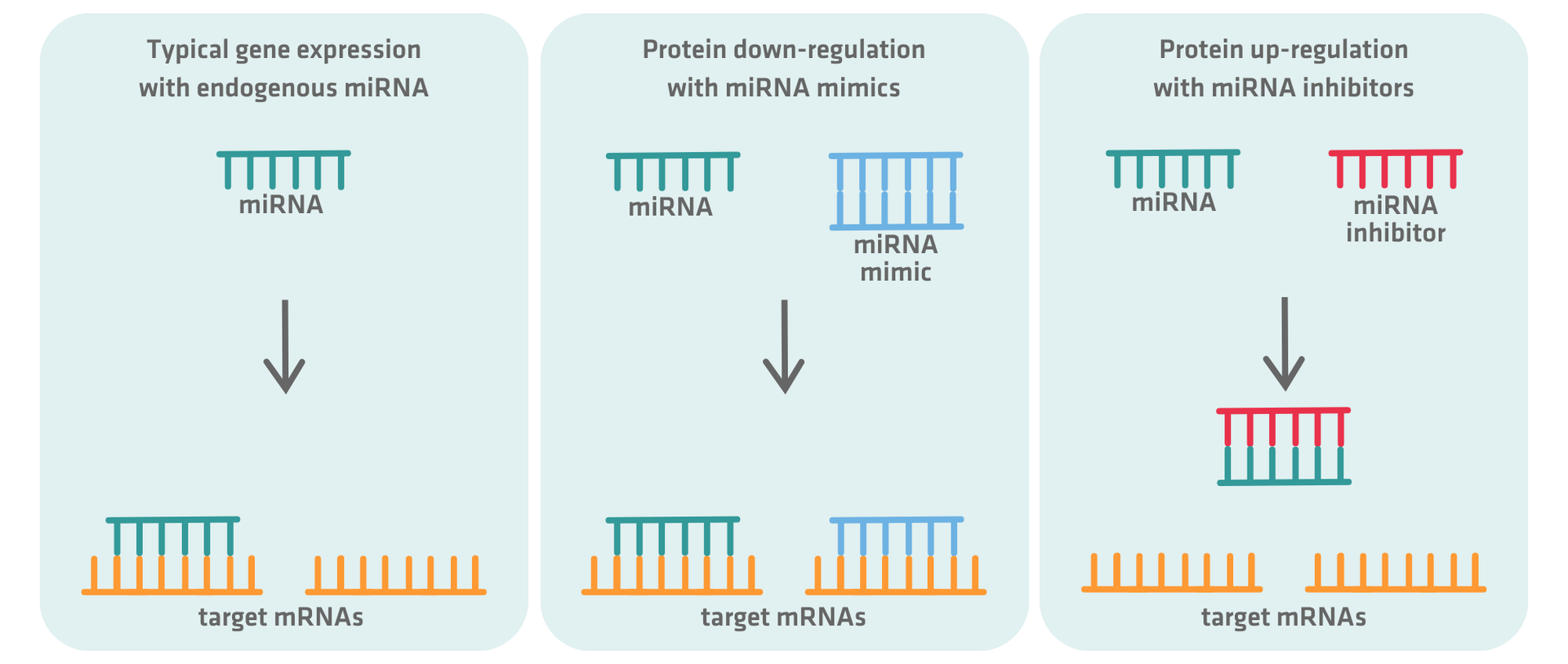
miRNA mimics and inhibitors lead to a transient knockdown or de-repression effect. For long-term applications, scientists need to use lentiviral shmiRs (short hairpin microRNAs) that infect target cells and integrate the shmiR sequence into the host genome, leading to a permanent, stable production of miRNAs.
RNAi therapeutics: from bench to bedside
Perhaps the most exciting frontier for RNAi is its application as a new class of medicine. The logic is compelling: if you can silence any gene with an siRNA designed to match its mRNA, then theoretically any disease-causing gene – including those encoding proteins long considered 'undruggable' – becomes a viable target. There are now several FDA approved siRNA-based therapeutics, all of which are delivered to the liver and treat a range of genetic cardiovascular diseases and metabolic disorders.
This leads us to a major limitation of siRNA-based drugs: delivering them to the right cells in the body. Naked siRNAs are rapidly degraded in the bloodstream by nucleases and are too large and negatively charged to cross cell membranes efficiently. Early approaches using lipid nanoparticles – essentially fatty vesicles that encapsulate the siRNA and fuse with cell membranes – proved effective for liver-targeted delivery and formed the basis of the first approved siRNA-based drugs. More recent strategies include conjugation of siRNAs to a sugar that binds to receptors highly expressed on hepatocytes, helping these liver cells to efficiently take up the siRNAs. Achieving efficient RNAi uptake in other tissues remains challenging and is an active area of research.
Limitations and considerations
In addition to the delivery challenge of siRNA-based drugs, there are other limitations of RNAi that researchers need to be aware of when designing experiments or developing new therapies.
siRNAs and siRNA-like molecules produced from shRNAs are designed to be perfectly complementary to 1 specific mRNA target. In theory, this should make them 100 % specific. In practice, RISC doesn't require full complementarity to bind and silence an mRNA target – partial matches are sufficient for at least some degree of repression. This means that siRNA and shRNAs can silence unintended genes if they have partial complementarity to non-target mRNAs. These off-target effects could lead to a misinterpretation of gene knockdown results, so researchers should always design multiple siRNAs or shRNAs targeting the same gene and compare the results of the different experiments with one another. If all the siRNAs or shRNAs produce the same result, off-target effects are much less likely and your results are more robust.
Just like miRNAs, miRNA mimics aren't specific to a single mRNA molecule but typically regulate multiple partially complementary targets. This means that multiple pathways are altered at once when mimics are introduced into a cell, making results harder to interpret. The same applies to miRNA inhibitors: even if they are designed to bind a single miRNA, inhibiting that miRNA will influence several cellular pathways, and off-target effects where the inhibitor blocks related miRNAs with similar sequences can occur as well. Also, the same miRNAs can have different targets and roles depending on cell type, developmental stage or disease state, so results obtained in 1 model may not translate directly to another.
Additional risks of RNAi-based techniques are:
- Immune response: a limitation to all the techniques is that siRNAs, shRNAs and miRNA mimics and inhibitors can trigger an immune response as an unintended side effect. In most experiments and applications, researchers try to avoid this by making chemical modifications and avoiding certain sequence motifs, but there are also efforts to harness this side effect to activate an innate and adaptive immune response for cancer and viral RNAi-based therapies.
- Pathway saturation: siRNAs, shRNAs, and miRNA mimics and inhibitors that are introduced into cells by scientists can overload the cell's endogenous regulatory machinery. They compete with endogenous molecules for binding to RISC and – in the case of shRNAs – also for nuclear export proteins. This competition can lead to gene dysregulation and cellular toxicity.
- Insertional mutagenesis: a limitation unique to shRNA transgenesis is that it can create unwanted mutations when inserting the shRNA sequence into the host's genome.
| siRNA transfection | shRNA transgenesis | miRNA mimics/inhibitors | |
| Delivery | Delivery into cytoplasm using lipid transfection | Integration into genome using viral vector | Delivery into cytoplasm using lipid transfection |
| Duration | Transient (~days) | Stable, permanent | Transient (mimics/inhibitors) or stable, permanent (lentiviral shmiRs) |
| Targets | 1 specific mRNA | 1 specific mRNA | Multiple mRNA targets (whole network) |
| Effect direction | Knockdown only | Knockdown only | Knockdown (mimics) or de-repression (inhibitors) |
| Main use | Rapid in vitro screens | Stable in vivo models | miRNA pathway research, disease |
| Key risk | Off-target effects, immune activation | Insertional mutagenesis, pathway saturation | Pleiotropic off-target network effects |
Conclusion
What began as an observation in a nematode worm has evolved into a Nobel Prize-winning discovery, a cornerstone technique in functional genomics, and a new class of approved medicines capable of specifically silencing disease-causing genes. If the challenge of delivering siRNAs not only to the liver but also to other cells and tissues can be solved, RNAi therapeutics could become standard in the treatment of hereditary diseases.
Did you like this article?
Subscribe to our blog for more!
Ask our expert. Leave a comment!
Write us if you have any questions regarding the blog article.