


-
Automated library preparation for a nanopore DNA barcoding protocol on the MIRO CANVAS
Enabling automation of multiplex library preparation using the Native Barcoding Kit from Oxford Nanopore Technologies
Long read sequencing allows the in-depth characterization of formerly unreadable regions, supporting de novo genome assembly and haplotype phasing.1
The Native Barcoding Kit (SQK-NBD114.24) uses DNA barcoding and multiplex nanopore sequencing to enable the identification of DNA molecules in a single sample that is being sequenced in parallel with other samples.2 It can use PCR amplicons or non-amplified DNA.3 This is important for applications where native DNA structure preservation is key – such as the analysis of base modifications, metagenomic and epigenetic studies – or when detecting species of interest, such as pathogens and their evasion mechanisms.4
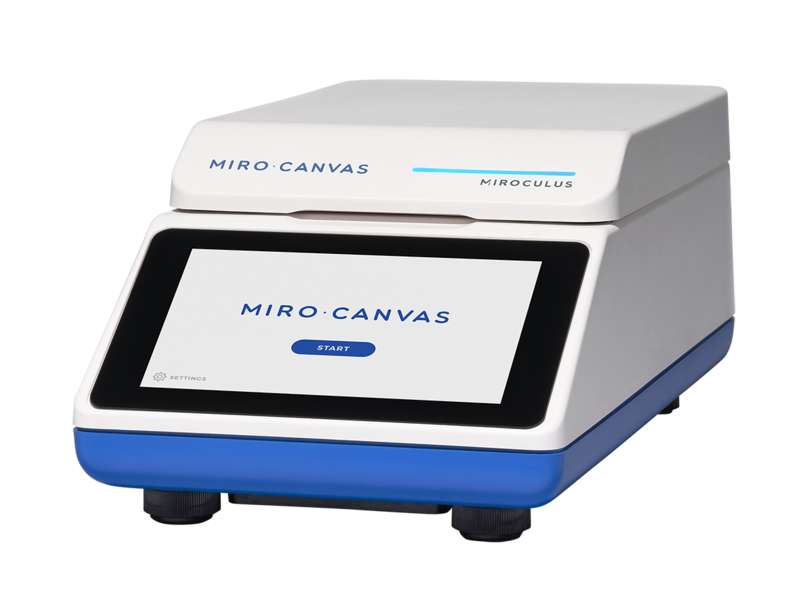
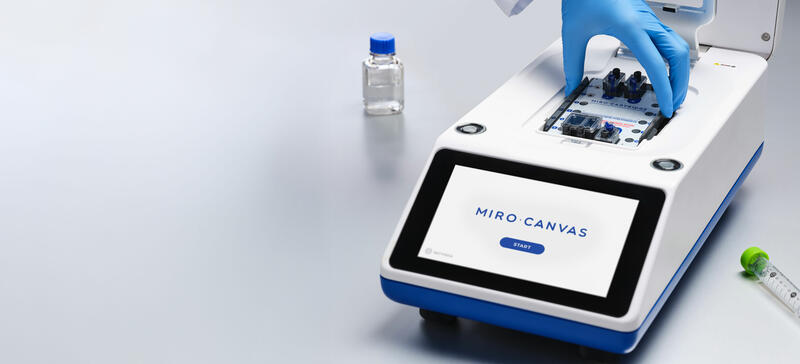
The MIRO CANVAS NGS prep system is a digital microfluidics platform that automates NGS library preparation. It is compact (20.2x40.6x17.6 cm, WxDxH), requires minimal infrastructure (a standard 120V adapter), and has been shown to work after air travel in carry-on baggage and in a backpack.This application note describes results from the Native Barcoding Kit partially automated on the MIRO CANVAS, which can handle up to 8 native barcoded samples or
>60 bead purified amplicon samples. -
Table of contents
Long read sequencing allows the in-depth characterization of formerly unreadable regions, supporting de novo genome assembly and haplotype phasing.1
The Native Barcoding Kit (SQK-NBD114.24) uses DNA barcoding and multiplex nanopore sequencing to enable the identification of DNA molecules in a single sample that is being sequenced in parallel with other samples.2 It can use PCR amplicons or non-amplified DNA.3 This is important for applications where native DNA structure preservation is key – such as the analysis of base modifications, metagenomic and epigenetic studies – or when detecting species of interest, such as pathogens and their evasion mechanisms.4
The MIRO CANVAS NGS prep system is a digital microfluidics platform that automates NGS library preparation. It is compact (20.2x40.6x17.6 cm, WxDxH), requires minimal infrastructure (a standard 120V adapter), and has been shown to work after air travel in carry-on baggage and in a backpack.This application note describes results from the Native Barcoding Kit partially automated on the MIRO CANVAS, which can handle up to 8 native barcoded samples or
>60 bead purified amplicon samples.
Key benefits
Overview: How to automate the Native Barcoding Kit on the MIRO CANVAS
Experimental set-up
This experiment used 3.2 μg of short read eliminated (PacBio PN: SKU 102-208-300) ZymoBIOMICS HMW DNA Standard (Zymo research PN: D6322) as input for both manual library preparation and libraries prepared on the MIRO CANVAS. 400 ng of each ZymoBIOMICS HWM DNA Standard was quantified using a broad range Qubit™ quantification kit, followed by manual end-prep, unique barcode ligation and pooling to create an 8-plex pool. Reagent volumes listed in the Native Barcoding Kit protocol were reduced by 50 % after the barcoding step. The MIRO CANVAS protocol was then used to automate bead clean-up, adapter ligation and final library bead clean-up, which was also performed manually in parallel.

Downloads: App note for fully automated DNA barcoding workflow
Results
Each prepared library pool was loaded into a R10.4.1 MinION flow cell and sequenced until ~5 Gb of data was obtained. Libraries prepared using the automated workflow on the MIRO CANVAS produced comparable read length distributions (Figure 2) and N50 read lengths (Table 1) to those prepared manually.

Representative sequencing metrics for libraries prepared manually and using the MIRO CANVAS are shown below. Read length (bp) and quality statistics are comparable between the MIRO CANVAS and manual preparation.
Table 1: Summary of the sequencing metrics for libraries prepared manually and using the MIRO CANVAS.

The 5 longest sequenced reads in the MIRO CANVAS library were all >150 kb, and greater in length than the 5 longest ranked reads from the manually prepared library pool (Figure 3). Additionally, the MIRO CANVAS had the higher mean call base quality score.

The ZymoBIOMICS HMW DNA Standard is composed of genomic DNA from 7 bacteria and 1 yeast species. All 8 species were identified through nanopore sequencing of libraries prepared both manually and using the MIRO CANVAS. Figure 4 shows how the cumulative reads of each species compare between manual and MIRO CANVAS runs.

The number of sequenced reads for each of the clinical samples was similar between pooled libraries for both the MIRO CANVAS and manual experiments. This reflected a balanced pool, where each barcode was +/-30 % read count on average, with no more than 20 % of barcodes falling outside the 30 % median bracket.
Similar results were obtained when the input DNA pool was comprised of pooled SARS-CoV-2 amplicons generated using the nanopore protocol pcr-tiling-SARS-CoV-2-nbd-PTCN_9103_v109_revR_13Jul2020-minion (data not shown, poster available upon request).

References
- Bayliss SC, Hunt VL, Yokohama M, Thorpe HA, Feil EJ. The use of Oxford Nanopore native barcoding for complete genome assembly. GigaScience. 2017 Mar; 6(3): doi: 10.1093/gigascience/gix001. PMID: 28327913.
- Florian T, Karen L, Emily F, Alon S, Hilary GM, Luis B, Bana J, Murat E. High molecular weight DNA extraction strategies for long-read sequencing of complex metagenomes. Microbiology Spectrum. 2022 Jul;22(5):1786-1802. doi: 10.1111/1755- 0998.13588. PMID: 35068060.
- Robert P, Kathleen V, Andrea S, Ellen F, Amanda E, Mihir SJ, Rebecca D, David R, Sarah G, Bruce G, Shanmuga S. Optimization of Oxford Nanopore Technology Sequencing Workflow for Detection of Amplicons in Real Time Using ONT-DART Tool. Genes (Basel). 2022 Oct 3;13(10):1785. doi: 10.3390/genes13101785. PMID: 36292670.
- Mojnu M, Mohammad EH, Rashedul H, Md Shaheen A, Joynob AP, Md Mahmudul H, Ariful I, Sukanta C, Mohammed ZR. Culture-Independent Workflow for Nanopore MinION-Based Sequencing of Influenza A Virus. Genes (Basel). 2022 Oct. 3;13(10):1785. doi: 10.3390/genes13101785. PMID: 37212605.
Conclusion
8-plex and/or amplicon DNA pools can be prepared on the MIRO CANVAS, as long as the pool volume is adjusted for loading compatibility.
Ask our expert. Leave a comment!
Write us if you have any questions regarding the application note or one of our instruments.
Any questions? I'm happy to help!
Instruments and accessories
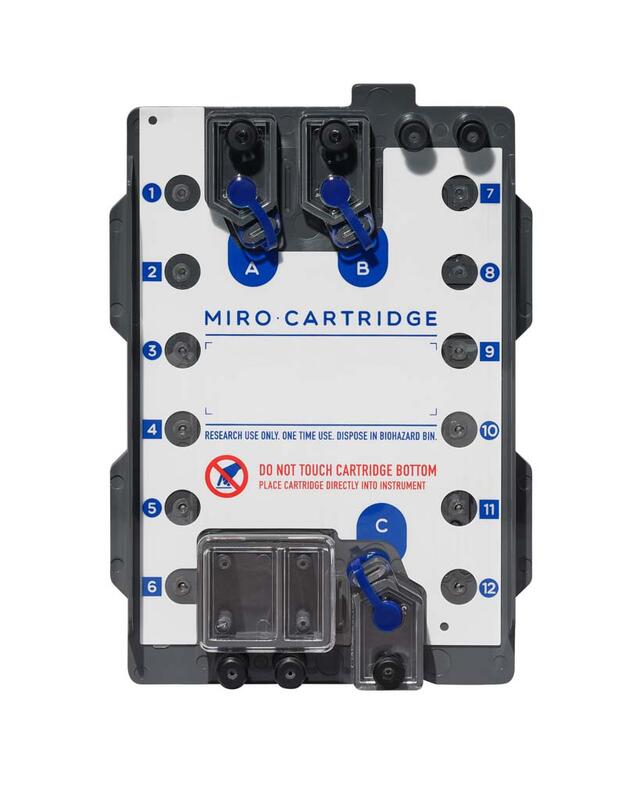
MIRO CANVAS, NGS prep system
A revolutionary microfluidics platform which enables full automation of NGS prep protocols.
-
Fully automated - Simple, walk-away automation for on-demand NGS sample preparation
-
Efficient - Minimize costs with up to 75 % reduction in reagent use and only 15 minutes of hands-on time
-
Flexible - Established NGS sample prep protocols for both short- and long-read sequencing platforms
Part No. M-01-0001-001-01
Downloads
Download App Note as PDF
DownloadAutomated library preparation for a nanopore DNA barcoding protocol on the MIRO CANVAS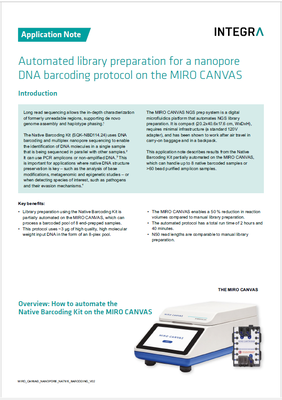
Related products


Applications
Show all-
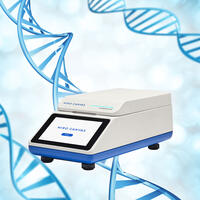
The MIRO CANVAS NGS prep system enables fully automated library prep for nanopore human whole genome sequencing (WGS)
-
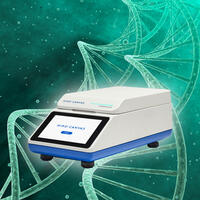
Enabling the Illumina DNA PCR-Free Library Prep kit on the MIRO CANVAS NGS prep system
-
Implementing the Twist Human Core Exome Kit on the MIRO CANVAS
-
Automating PacBio® SMRTbell® whole genome sequencing library prep on the MIRO CANVAS
Stories
Show all-
 · Product News
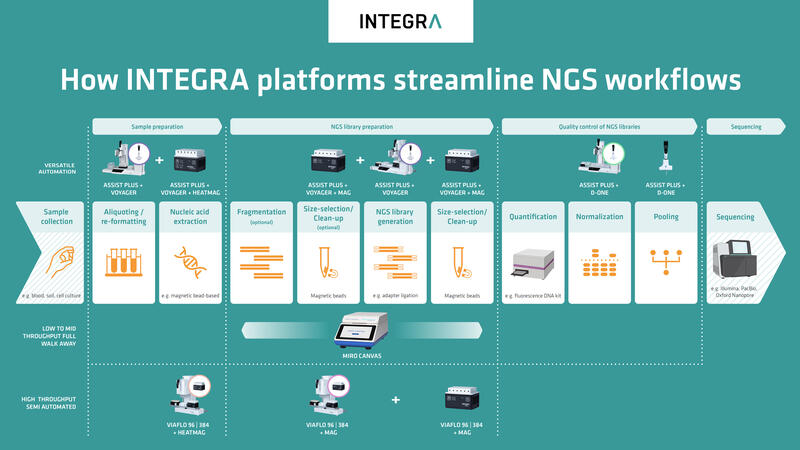
How our liquid handling solutions streamline NGS workflows
-
 · Product News
New digital microfluidics platform fully automates NGS sample preparation
-
 · Product News
Streamline your NGS workflow (Webinar)
-
 · Customer Testimonial
Exploring the human microbiome with automated NGS library prep
-
 · Customer Testimonial
Revolutionizing NGS library preparation with automated liquid handling integration