


-
Easy set-up for high throughput protein crystallization experiments using the VIAFLO 96 and VIAFLO 384 handheld electronic pipette
How INTEGRA’s 96 channel electronic pipette aids liquid transfers in 96 well plates for sitting drop vapor diffusion crystallization screens
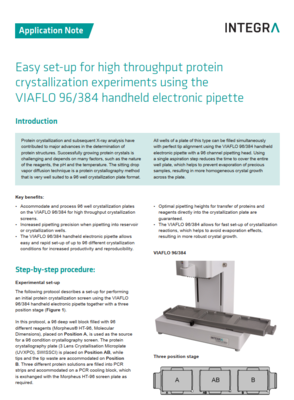
Protein crystallization and subsequent X-ray analysis have contributed to major advances in the determination of protein structures. Successfully growing protein crystals is challenging and depends on many factors, such as the nature of the reagents, the pH and the temperature. The sitting drop vapor diffusion technique is a protein crystallography method that is very well suited to a 96 well crystallization plate format. All wells of a plate of this type can be filled simultaneously with perfect tip alignment using the VIAFLO 96/384 handheld electronic pipette with a 96 channel pipetting head. Using a single aspiration step reduces the time to cover the entire well plate, which helps to prevent evaporation of precious samples, resulting in more homogeneous crystal growth across the plate.
-
Table of contents
Protein crystallization and subsequent X-ray analysis have contributed to major advances in the determination of protein structures. Successfully growing protein crystals is challenging and depends on many factors, such as the nature of the reagents, the pH and the temperature. The sitting drop vapor diffusion technique is a protein crystallography method that is very well suited to a 96 well crystallization plate format. All wells of a plate of this type can be filled simultaneously with perfect tip alignment using the VIAFLO 96/384 handheld electronic pipette with a 96 channel pipetting head. Using a single aspiration step reduces the time to cover the entire well plate, which helps to prevent evaporation of precious samples, resulting in more homogeneous crystal growth across the plate.
Key benefits
Experimental set-up
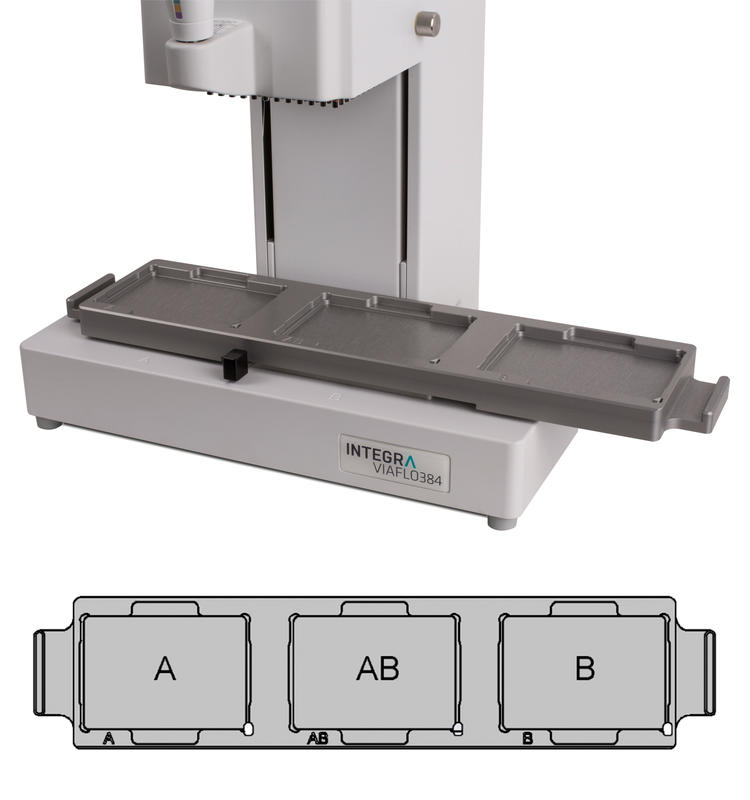
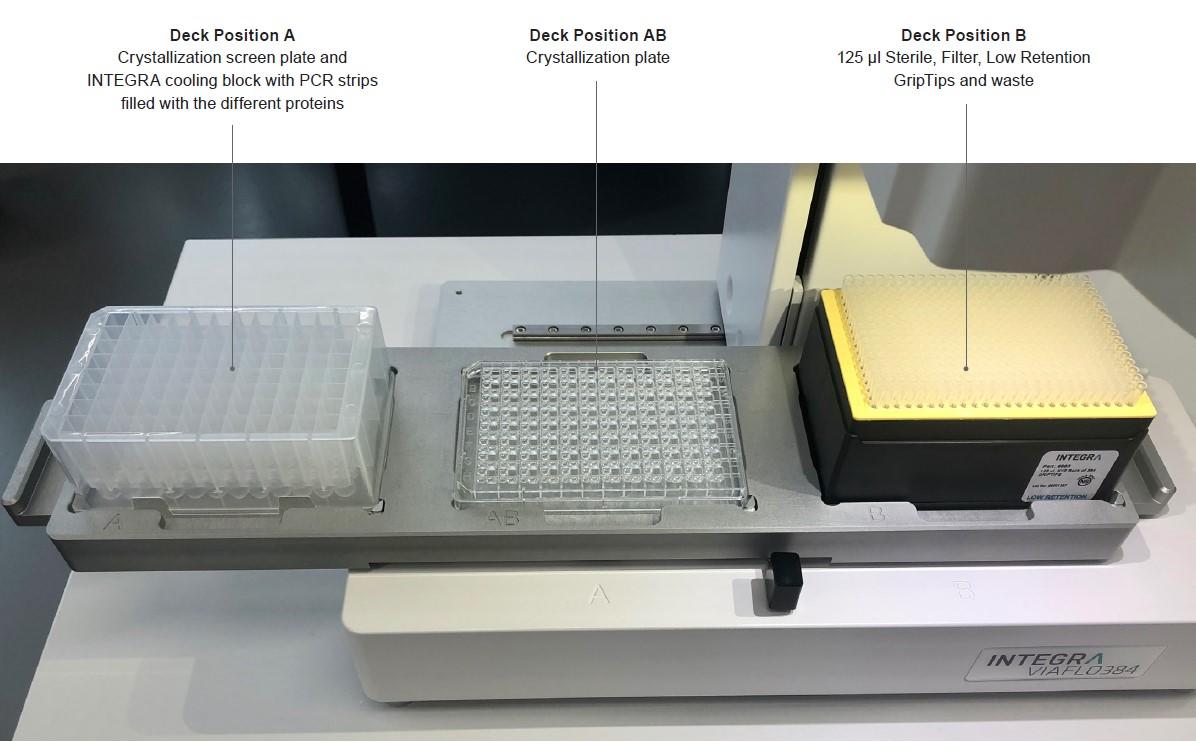
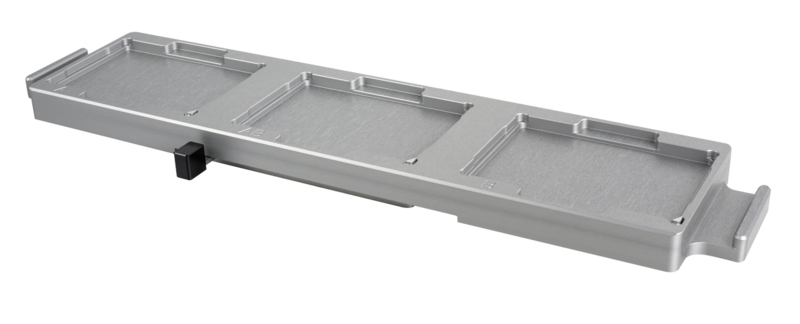
The following protocol describes a set-up for performing an initial protein crystallization screen using the VIAFLO 96/384 handheld electronic pipette together with a three position stage (Figure 1).
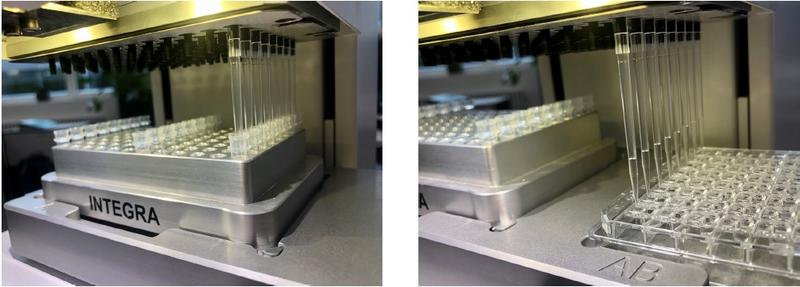
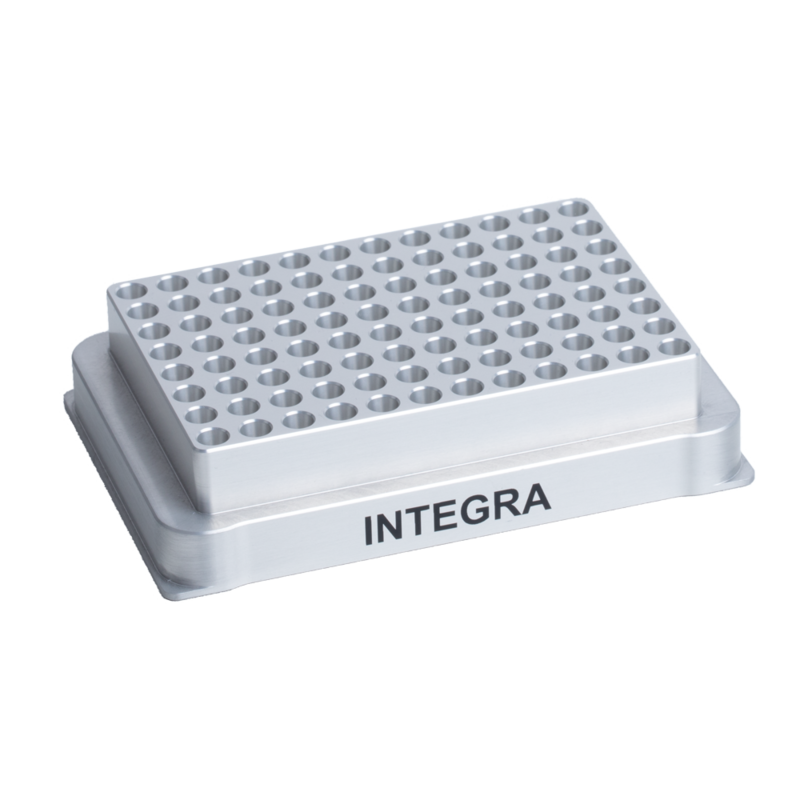
In this protocol, a 96 deep well block filled with 96 different reagents (Morpheus® HT-96, Molecular Dimensions), placed on Position A, is used as the source for a 96 condition crystallography screen. The protein crystallography plate (3 Lens Crystallisation Microplate (UVXPO), SWISSCI) is placed on Position AB, while tips and the tip waste are accommodated on Position B. Three different protein solutions are filled into PCR strips and accommodated on a PCR cooling block, which is exchanged with the Morpheus HT-96 screen plate as required.
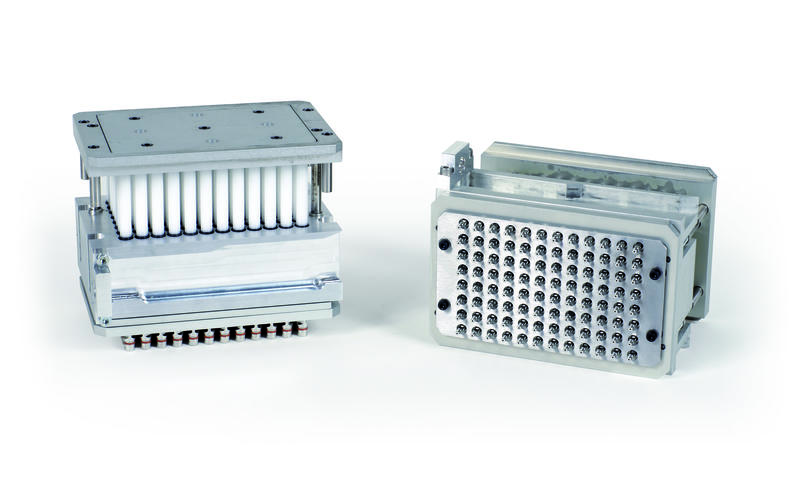
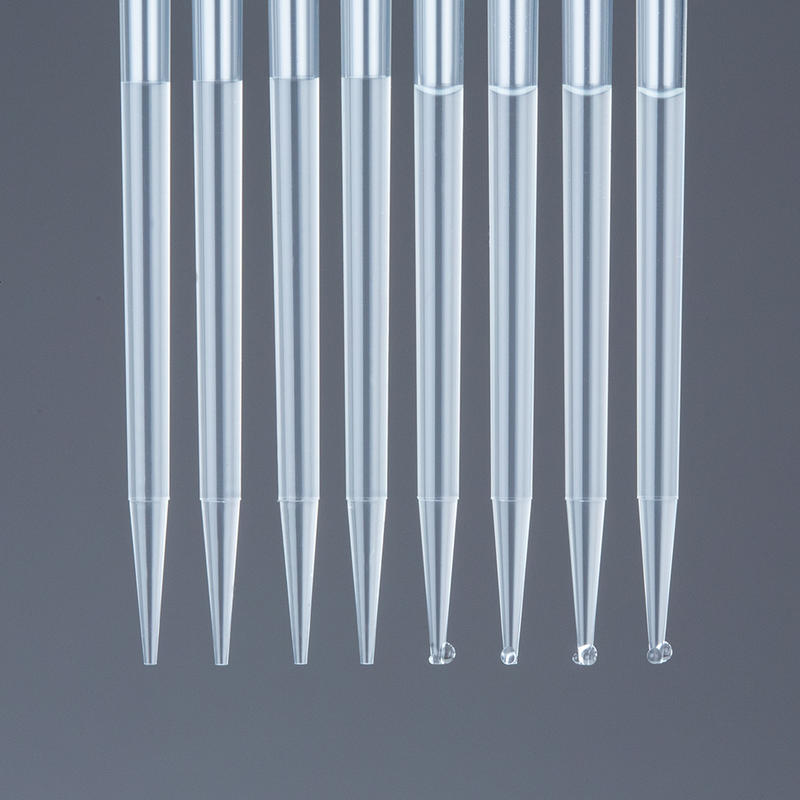
A 96 channel pipetting head (2-50 μl) is used together with 125 μl Sterile, Filter, Low Retention GRIPTIPS®. Customized VIALINK programs are provided to set up a protein crystallization screen with the VIAFLO 96/384 handheld electronic pipette.
Downloads: Protocols for automated protein crystallization with VIAFLO 96 and VIAFLO 384
Here you can download the complete protocols used in this application and use them on your VIAFLO 96 and VIAFLO 384. The protocol can be customized with the VIALINK software.
Step-by-step procedure:
1. Transfer of the screening agents
Transfer the crystallization screening agents into each well of the crystallization plate
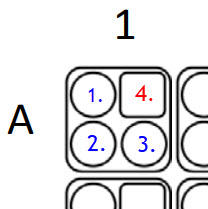
Load tips and launch the program ‘CRYST_SCREEN’ to fill the lens and reservoir wells (Figure 2) of the crystallization plate with the crystallization screening agents. Aspirate 40 μl of the Morpheus HT-96 reagent and dispense 2 μl back into the 96 deep well block (Position A), as indicated in the pipetting program. Dispense 2 μl into each lens well (1-3), and 30 μl into the reservoir well (4), of the crystallization plate on Position AB according to Figure 2. Move the plate slider of the three position stage to access the different wells of the crystallization plate more easily. Discard the pipette tips with the remaining liquid. The accuracy of these pipetting steps is increased by using a pre- and post-dispense.
Tips:
- Pipetting heights are defined in the program to prevent the tips from touching the bottom of the plate.
- The volumes dispensed can be easily adjusted to allow investigation of different ratios of protein and precipitant.
2. Transfer of protein solutions
Transfer up to three different protein solutions into the wells of the crystallization plate.
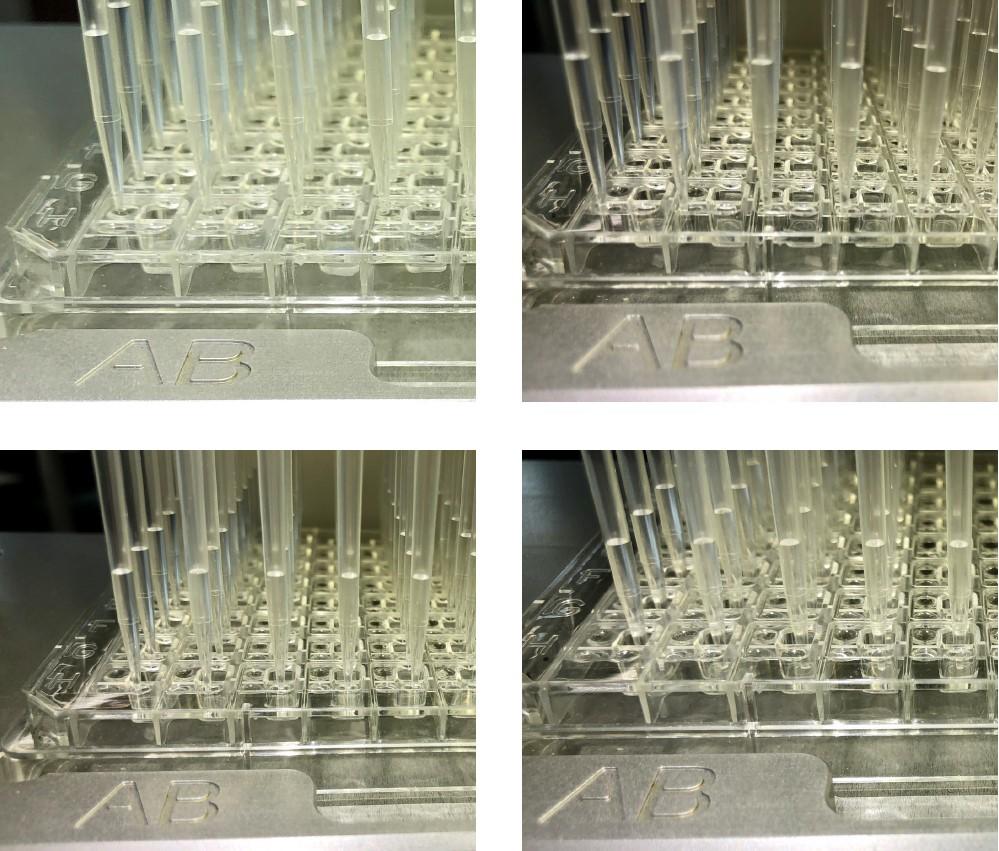
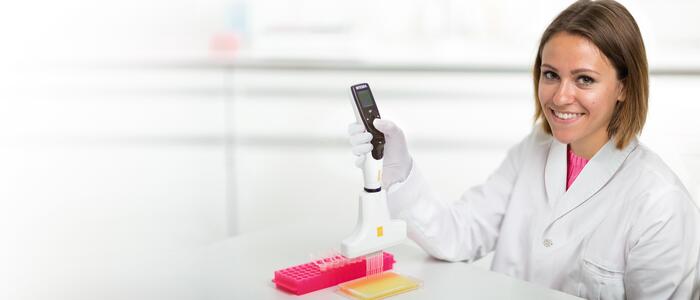
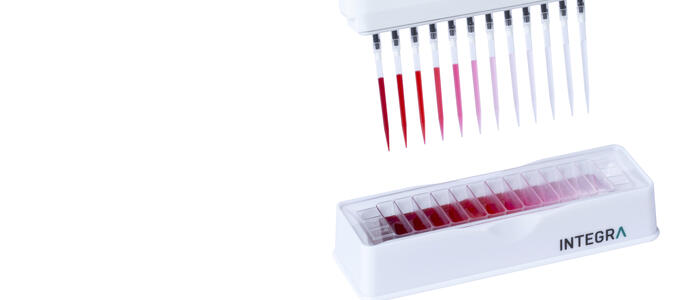
30 μl of each of the three different protein solutions are manually distributed into 8 tubes of a PCR strip to allow subsequent aspiration with 8 pipette channels in parallel. The PCR strip containing protein solution 1 is positioned in column 12 of a cooling block, which acts as a support. Instead of loading all 96 tips at once, load 8 tips to the last column of the pipetting head and aspirate 28 μl of protein solution 1. Perform a predispense (2 μl) and then transfer 2 μl to lens well 1 (Figure 2) of each column of the crystallization plate (Figure 4). Perform a post-dispense (2 μl). Discard the tips and exchange the PCR strip for one containing protein solution 2. Transfer the protein solution into lens well 2. Repeat the process for protein solution 3 and lens well 3.
Tips:
- Aspiration and dispense speeds can be easily adapted to allow optimized handling of the protein solutions.
- The column detect mode of the VIAFLO 96/384 handheld electronic pipette offers users haptic feedback for accurate and easier guidance when moving to the next column.
- Protein solutions can be kept chilled in the cooling block if necessary.
- Protein solutions can also be stored in a 12 column reagent reservoir if higher volumes of the protein solution are available. The corresponding VIALINK program can be found in the download section.
- Alternatively, 2 μl of protein solution can be transferred from a PCR strip into the crystallization wells using a VOYAGER 8 channel 12.5 μl adjustable tip spacing electronic pipette with 12.5 μl Sterile, Filter, Low Retention GRIPTIPS.
3. Sealing of the crystallization plate
Seal and incubate the crystallization plate.
Tip:
- The duration and temperature of sitting drop vapor diffusion depends on your proteins.
Conclusion
Ask our expert. Leave a comment!
Write us if you have any questions regarding the application note or one of our instruments.
Any questions? I'm happy to help!
Instruments and accessories
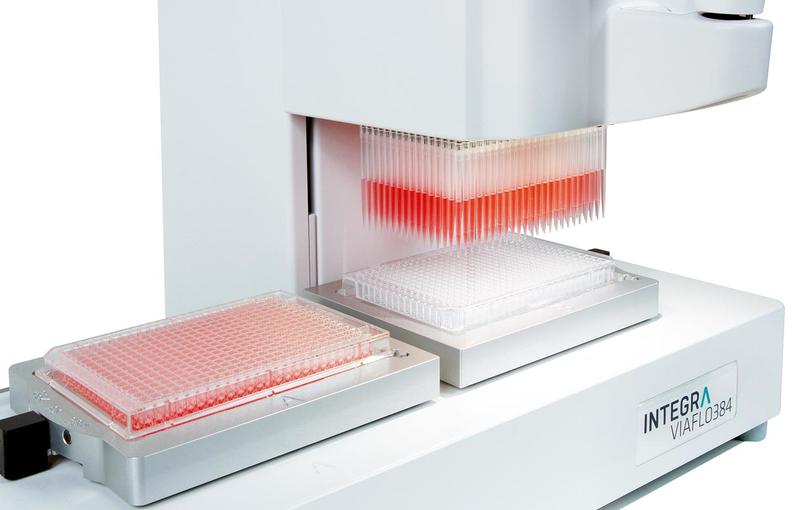
VIAFLO 96/ VIAFLO 384, Handheld Electronic Pipette
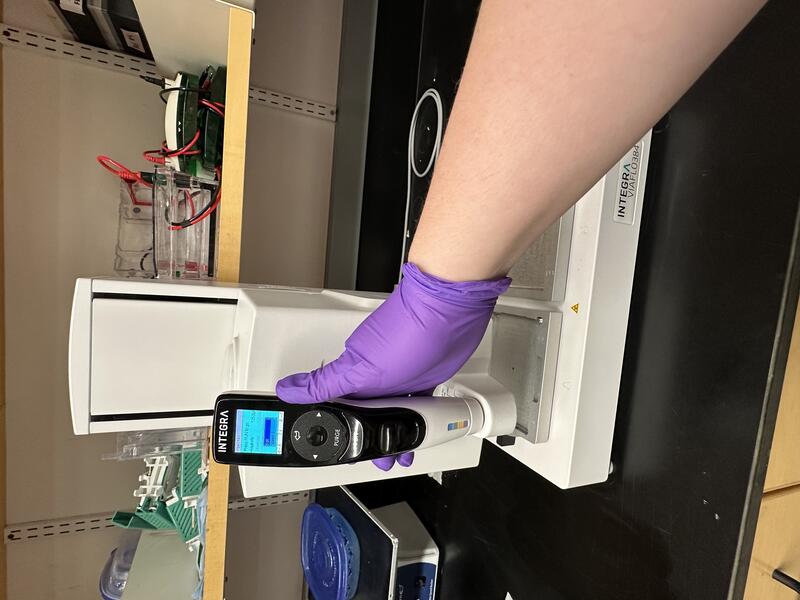
With this 24, 96 and 384 channel pipette, INTEGRA meets the need for an affordable, compact and easy to use pipette that provides increased productivity. The unique operating concept makes VIAFLO 96/384 as easy to use as any traditional handheld pipette.
Part No. 6001 / 6031
Customer’s voice
This is a very solid reliable machine. Makes cell plating a lot easier with accuracy and reduced strain on arms and shoulders. Also provide flexibility by allowing to swap out heads for different occasions.
Related products

Applications
Show all-
Enhanced workflow for high throughput, high density microelectrode array (HD-MEA) electrophysiology on MaxTwo 24-Well Plates
-
Cost-efficient miniaturization of 16S metagenomic library preparation
-
Efficient high throughput scNMT profiling with the VIAFLO 384
-
Affordable, high throughput bulk RNA barcoding and sequencing plate preparation with the VIAFLO 384
Stories
Show all-
 · Customer Testimonial
Streamlining hepatitis C vaccine research using VIAFLO pipettes
-
 · Product News
Magnetic beads for NGS size selection and PCR purification
-
 · Customer Testimonial
QIAGEN is accelerating PCR sample prep with our flexible pipetting solutions
-
 · Product News
Ergonomic pipettes and pipetting guidelines