


-
Easy 2-step sample preparation for LC-MS analysis on the ASSIST PLUS pipetting robot
LC-MS sample preparation
Liquid chromatography mass spectrometry (LC-MS) is commonly used in analytical chemistry workflows to separate, identify, and quantify complex samples. It plays a vital role in areas such as environmental monitoring, cosmetics industry, and pharma. Varying pipetting and dilution steps during sample preparation, however, are time consuming and prone to error when performed manually.
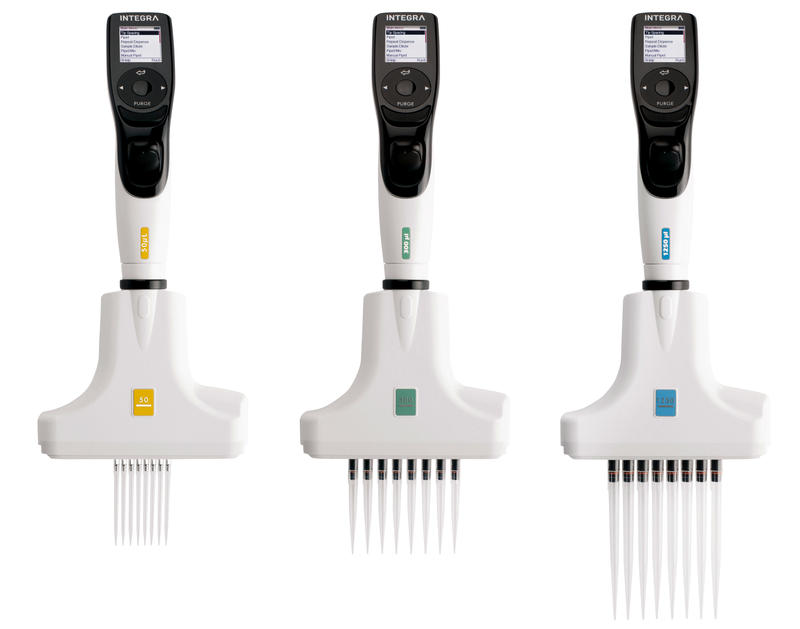
The VOYAGER adjustable tip spacing pipette on the ASSIST PLUS pipetting robot can access hazardous compounds from any tube format without exposing the user to danger. In addition, the ASSIST PLUS can take advantage of the D-ONE single channel pipetting module’s broad volume range and in combination with VIALAB worklist step, individual high volume sample dilutions are easier than ever. Reward yourself with reproducible results, additional hands-free time and profit from the versatility of the ASSIST PLUS.
-
Table of contents
Liquid chromatography mass spectrometry (LC-MS) is commonly used in analytical chemistry workflows to separate, identify, and quantify complex samples. It plays a vital role in areas such as environmental monitoring, cosmetics industry, and pharma. Varying pipetting and dilution steps during sample preparation, however, are time consuming and prone to error when performed manually.
The VOYAGER adjustable tip spacing pipette on the ASSIST PLUS pipetting robot can access hazardous compounds from any tube format without exposing the user to danger. In addition, the ASSIST PLUS can take advantage of the D-ONE single channel pipetting module’s broad volume range and in combination with VIALAB worklist step, individual high volume sample dilutions are easier than ever. Reward yourself with reproducible results, additional hands-free time and profit from the versatility of the ASSIST PLUS.
Key benefits
Overview: How to make sample preparation for LC-MS analysis easy
Downloads: App note and protocols for sample preparation for LC-MS analysis with the ASSIST PLUS pipetting robot
Experimental set-up
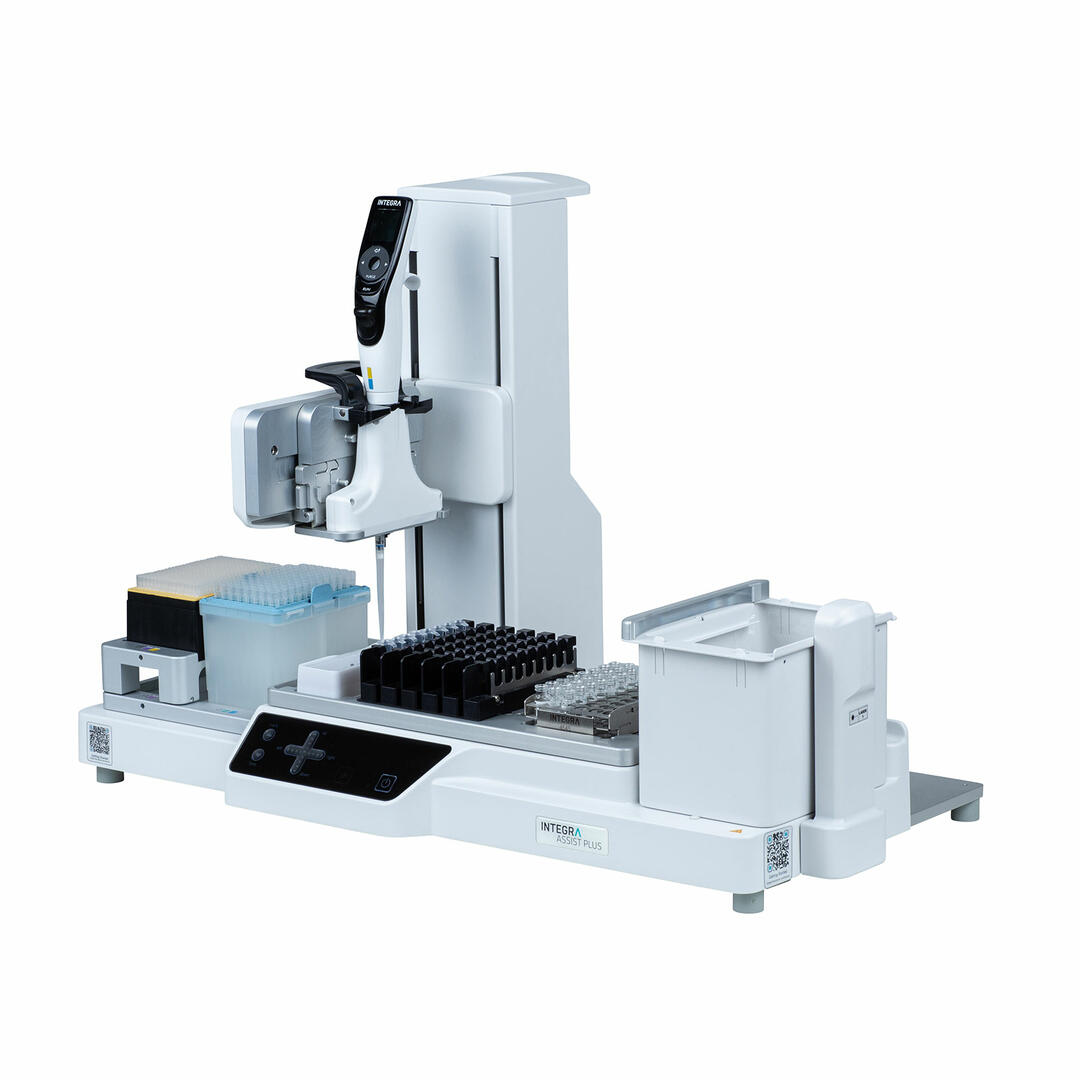
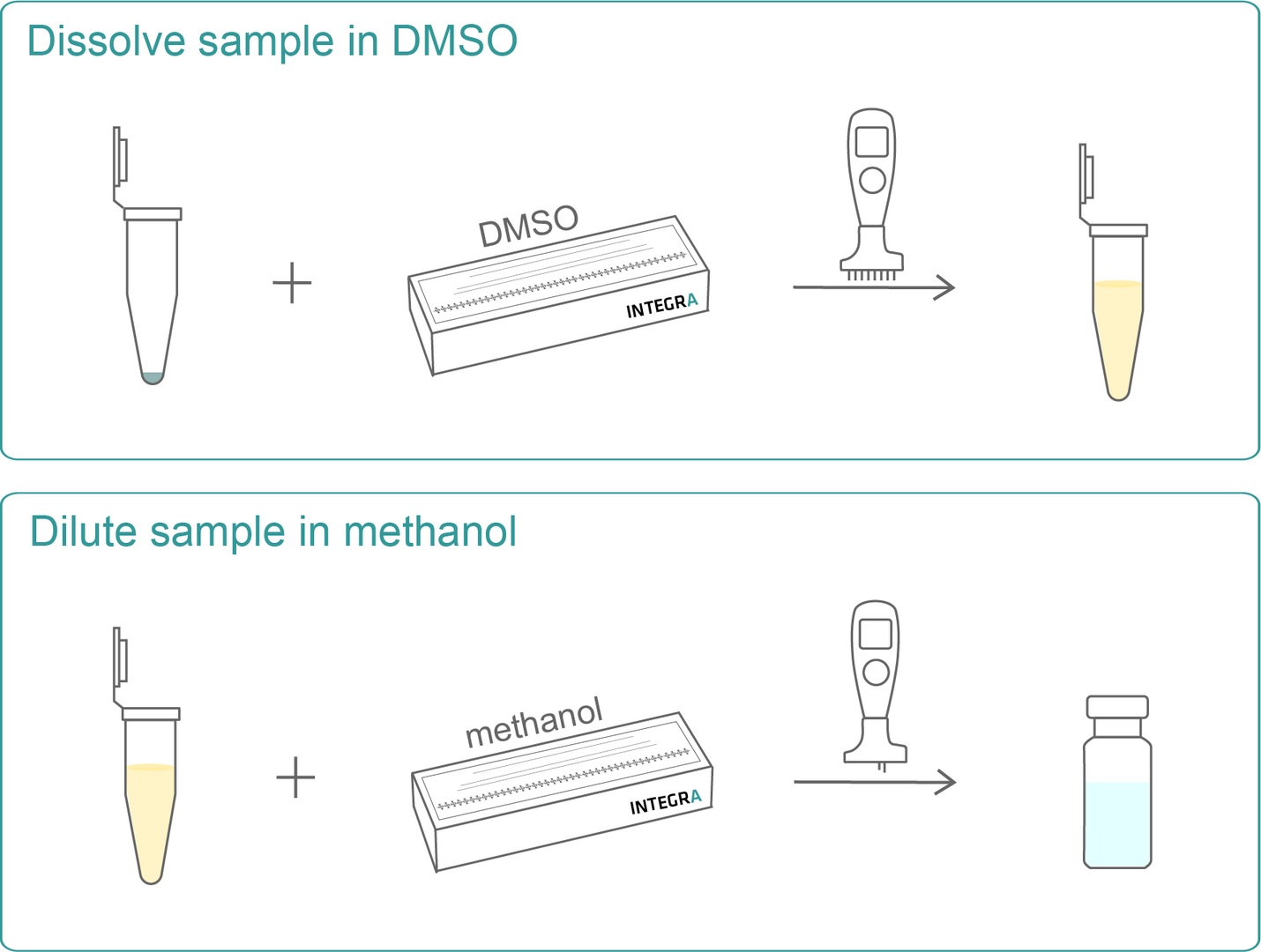
Experience reproducible results while having your hands free by using our easy sample preparation protocols for peptides, including high volume dilutions for LC-MS analysis (Figure 1).
Step-by-step procedure
1. Dissolve samples in DMSO
Dissolve freeze-dried peptides in 100 % DMSO
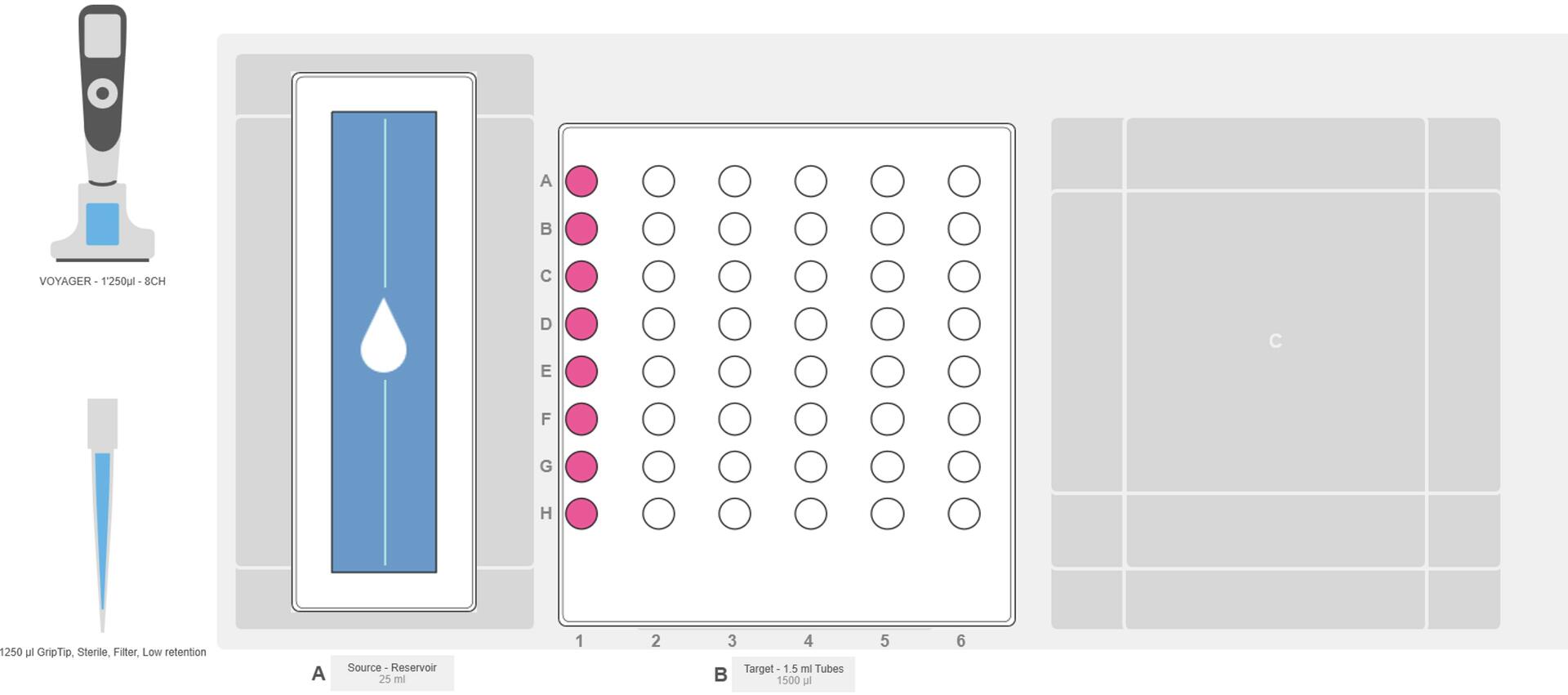
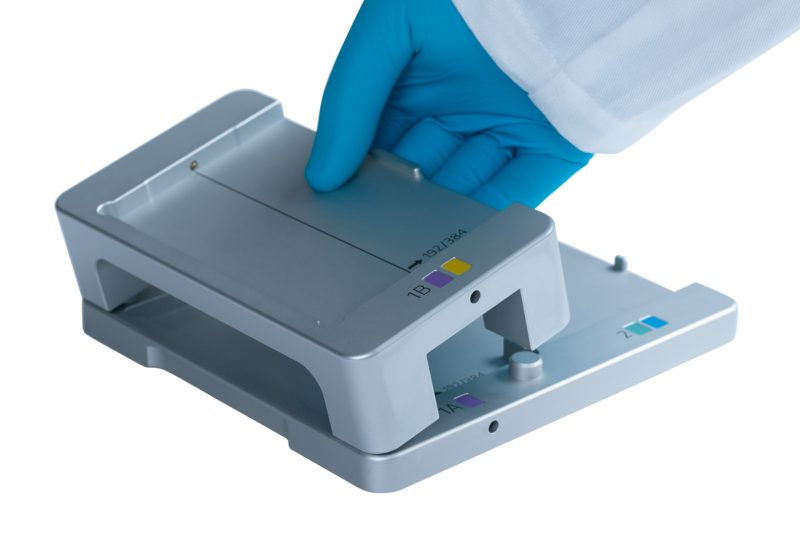
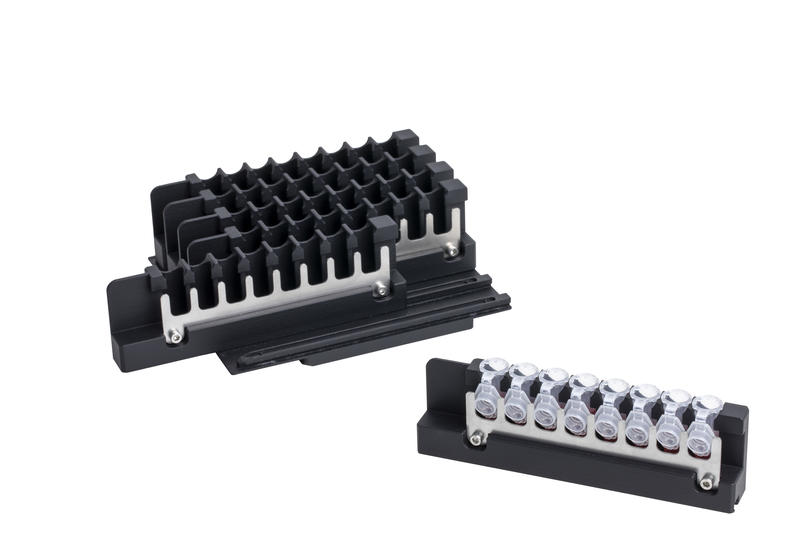
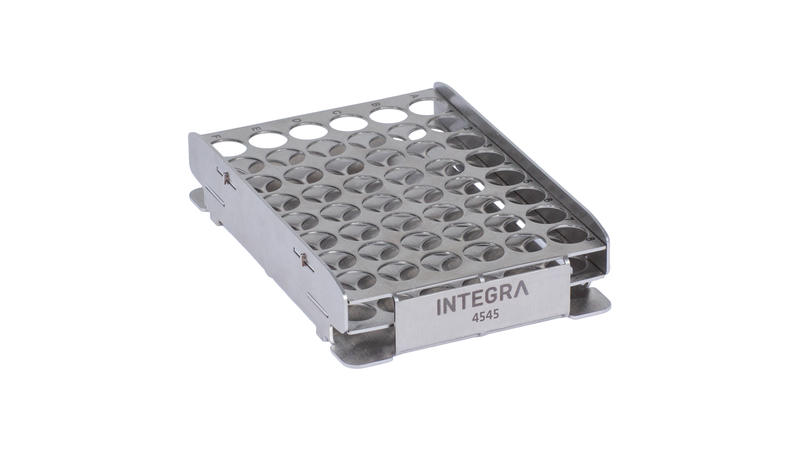
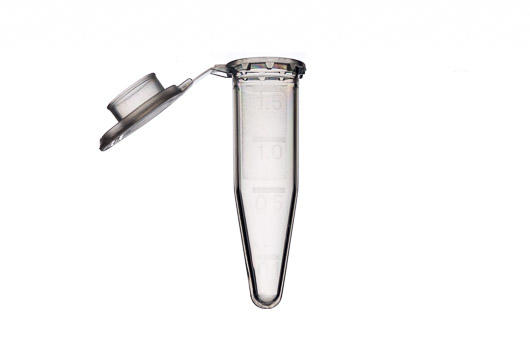
Place a 25 ml multichannel reagent reservoir filled with 10 ml of 100 % DMSO on deck position A (Figure 2, blue), and an INTEGRA rack with 1.5 ml microcentrifuge tubes containing freeze-dried peptides on deck position B (Figure 2, pink).
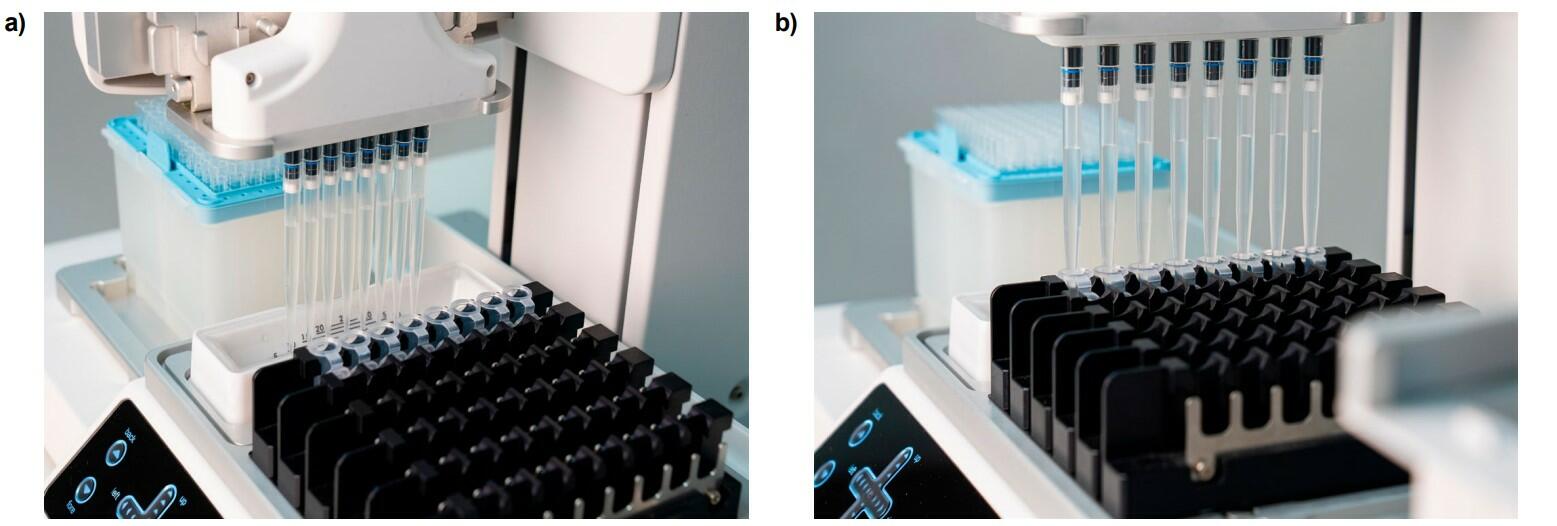
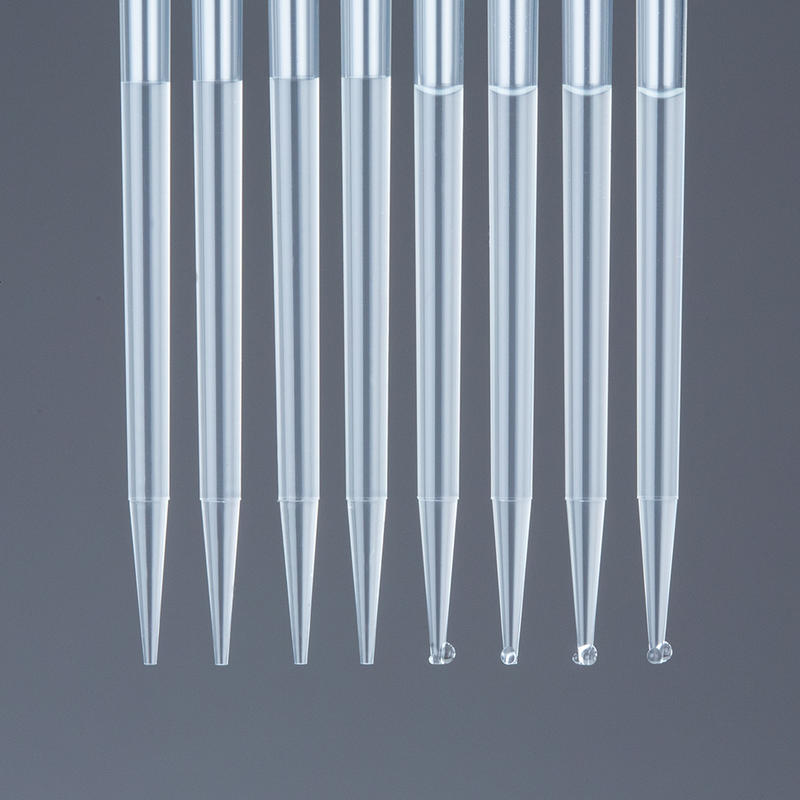
Select and run the VIALAB program ‘Dissolve_samples_in_DMSO'. With 1250 µl low retention, sterile, filter GRIPTIPS, the 8 channel 1250 µl VOYAGER adjustable tip spacing pipette aspirates 1 ml of DMSO from the reservoir (Figure 3a) and dispenses it into the 1.5 ml centrifuge tubes on deck position B (Figure 3b). Mixing 10 times at a gentle speed (6) ensures a homogeneous solution of peptides.
Tips:
- Easy adjustment of mixing parameters in VIALAB helps mix reagents of different solubilities.
- Accurate pipetting of DMSO with low retention GRIPTIPS and a reduced pipetting speed.
2. Dilute samples in methanol
Worklist set-up for individual peptide dilutions
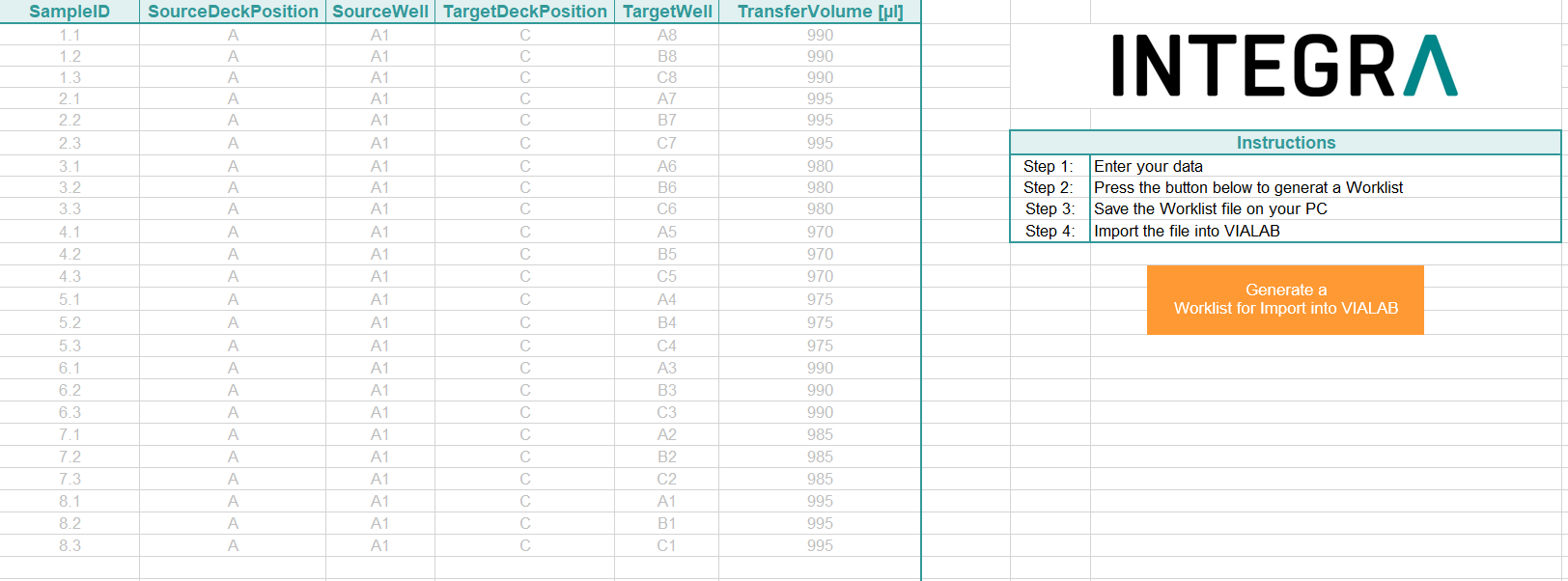
.csv files are created using the VIALAB worklist template (Figure 4) or imported directly into the VIALAB worklist step. The first worklist step includes the worklist for diluent distribution to analyze eight peptides in triplicates, and the second worklist step, the worklist for the different peptides.
Tips:
- Worry-free exchange of worklists for different sample dilutions without changing the VIALAB program.
- Quick adaption to varying sample counts when deselecting samples in the worklist step.
Sample dilution with methanol in triplicates
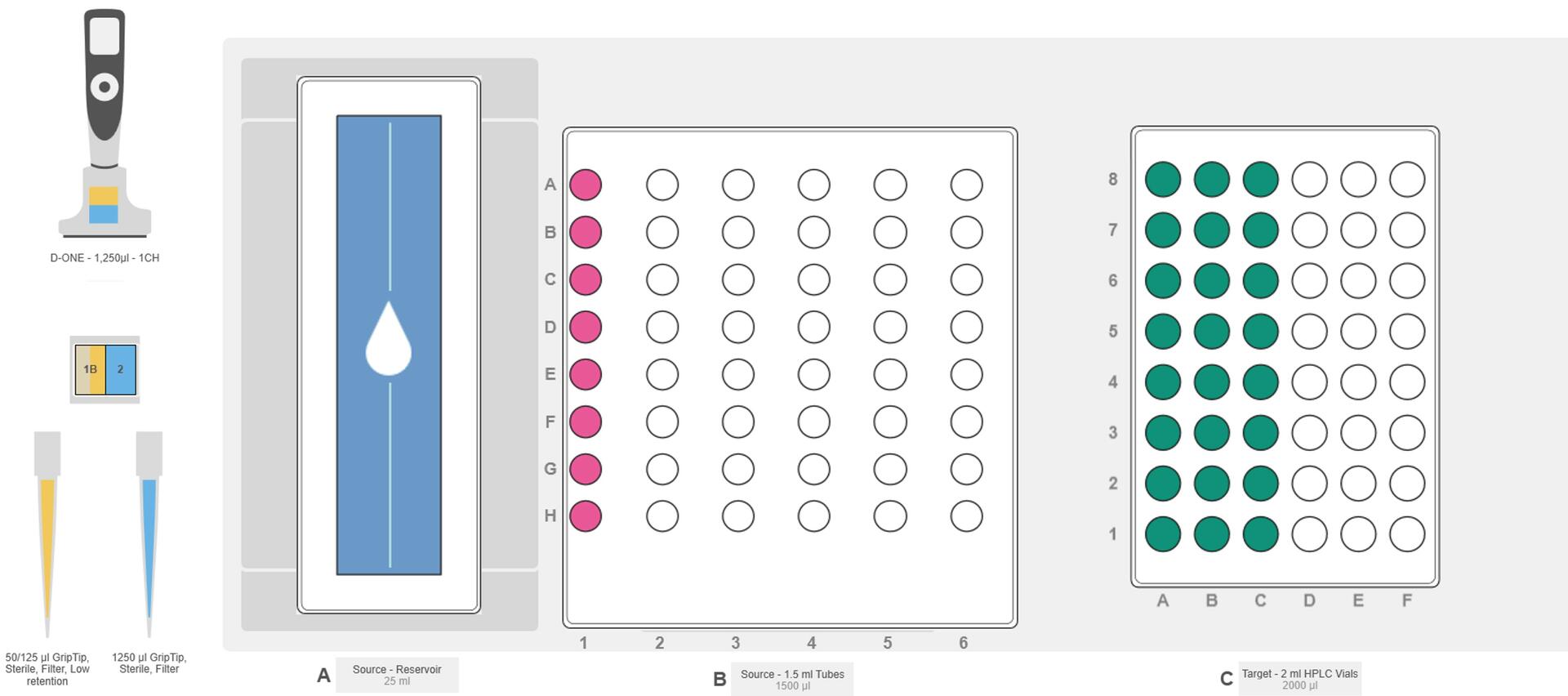
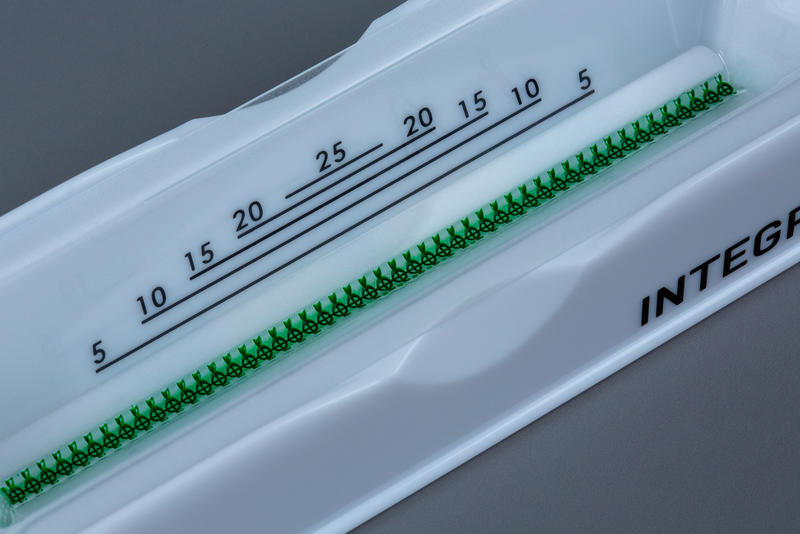
A 25 ml multichannel reagent reservoir filled with 25 ml of 100 % methanol is placed on deck position A (Figure 5, blue), and dissolved peptides in 1.5 ml tubes with an INTEGRA rack on deck position B (Figure 5, pink). An INTEGRA rack with 24 empty HPLC vials is placed on deck position C (Figure 5, green).
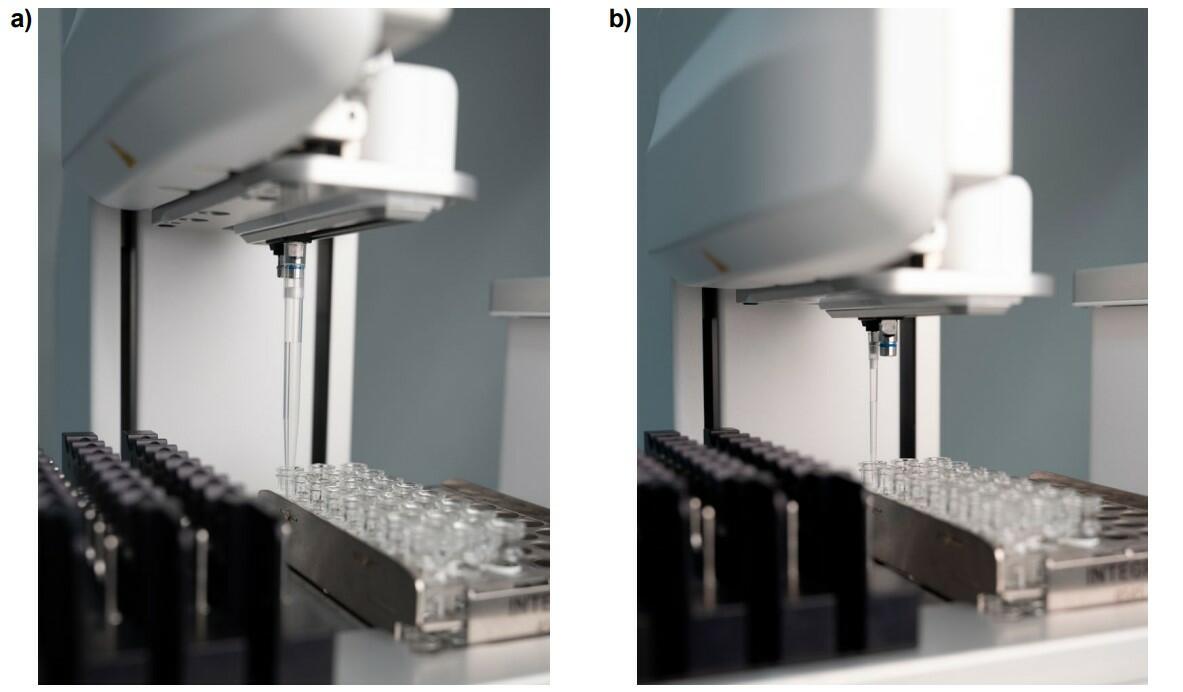
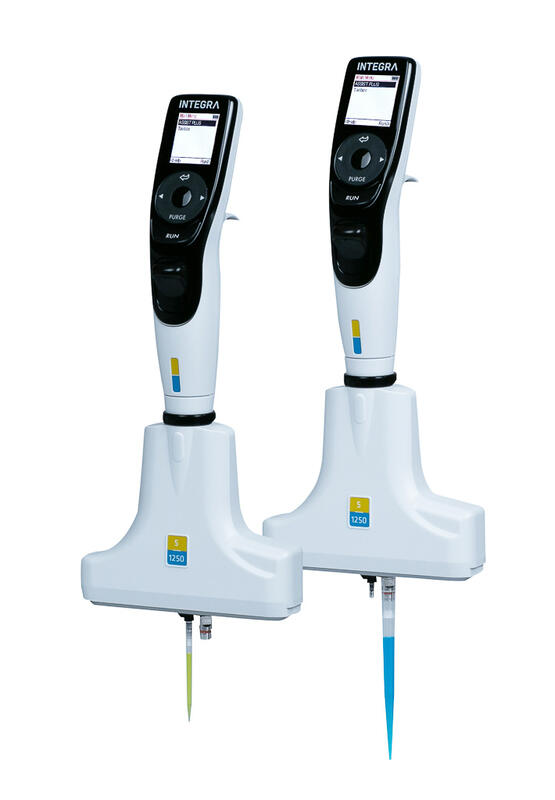
Select and run the VIALAB program ‘Dilute_samples_with_methanol’. The D-ONE single channel pipetting module on the ASSIST PLUS pipetting robot with 1250 µl sterile, filter GRIPTIPS distributes diluent from position A to position C (Figure 6a) as indicated in ‘worklist_diluent’. An initial tip pre-wetting prevents dripping when pipetting volatile liquids by saturating GRIPTIPS with vapor. Decreasing the speed to 5 with a one second delay after pipetting followed by a tip touch against the side of the HPLC vial, increases accuracy when dispensing methanol. The D-ONE then individually dilutes peptides from position B to position C (Figure 6b) in triplicates using 125 µl low retention, sterile, filter GRIPTIPS, as indicated in ‘worklist_samples’. Every peptide is mixed five times with the full 125 µl GRIPTIP volume.
Tips:
- Worry-free use of different sample aliquots with the D-ONE's LLD function.
- Avoid dripping caused by vibrations with reduced movement speeds during pipette travel.
- Risk-free methanol pipetting because the ASSIST PLUS fits easily in a fume hood.
Remarks
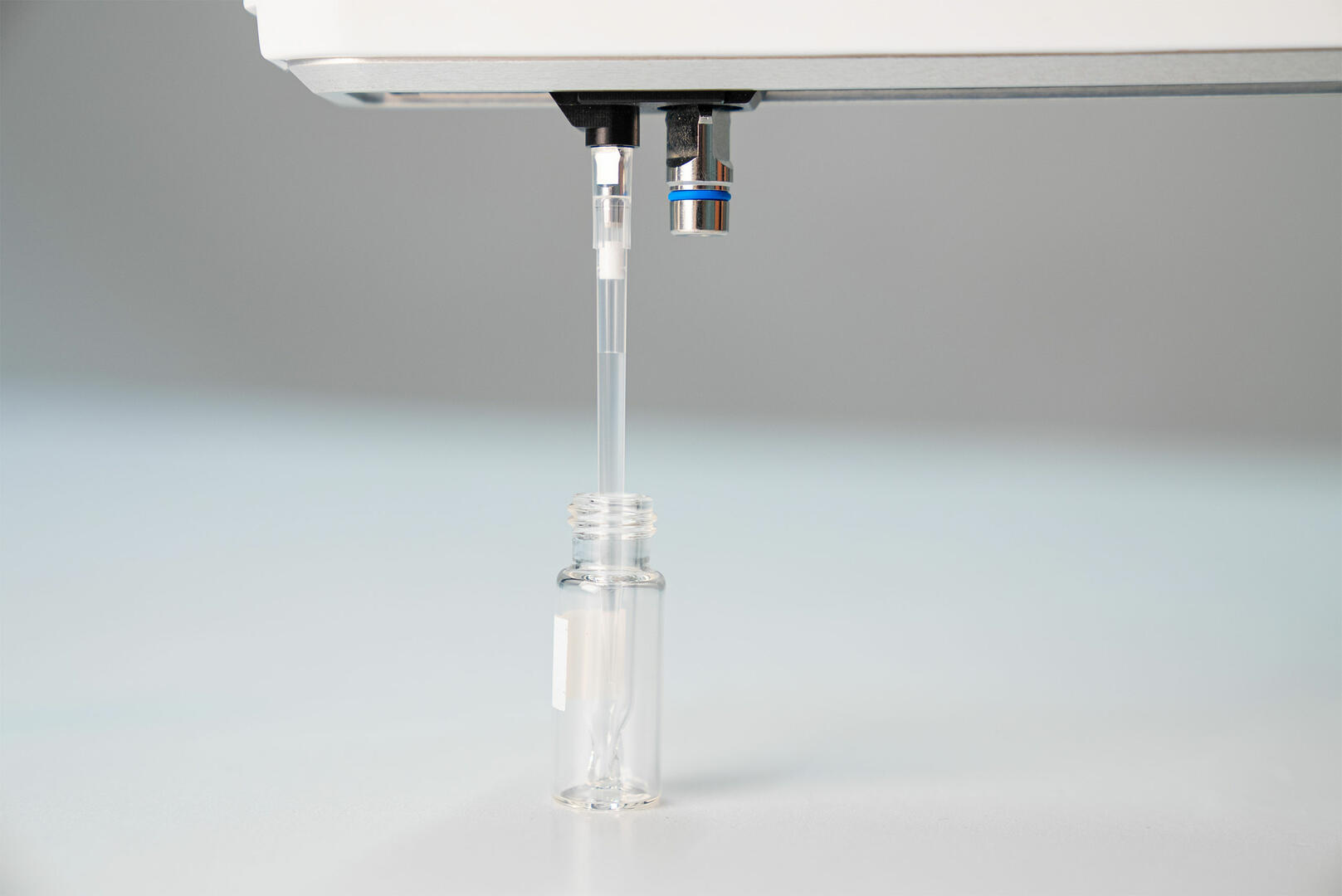
- Low volume HPLC vials: Special low volume HPLC vials with inlets are compatible with the INTEGRA rack for HPLC vials and accessible by the D-ONE (Figure 7).
- VIALAB software: The VIALAB programs can be easily adapted to your specific labware and protocols, for instance when partial plates are needed.
- Partial plates: Programs can be adapted at any time to a different number of samples, giving laboratories total flexibility to meet current and future demands.
Conclusion
ASSIST PLUS.
Ask our expert. Leave a comment!
Write us if you have any questions regarding the application note or one of our instruments.
Any questions? I'm happy to help!
Instruments and accessories
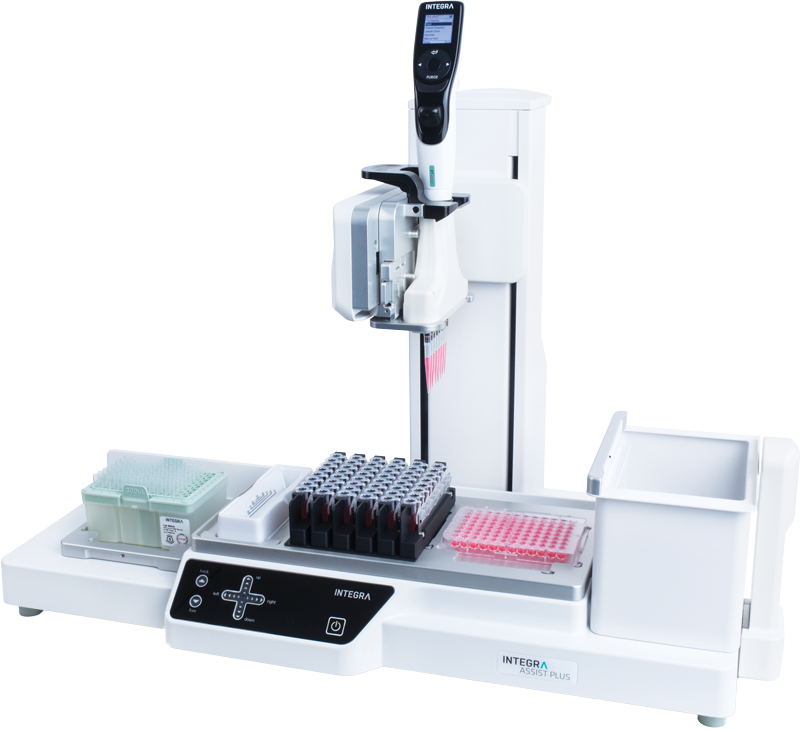
ASSIST PLUS, Pipetting Robot
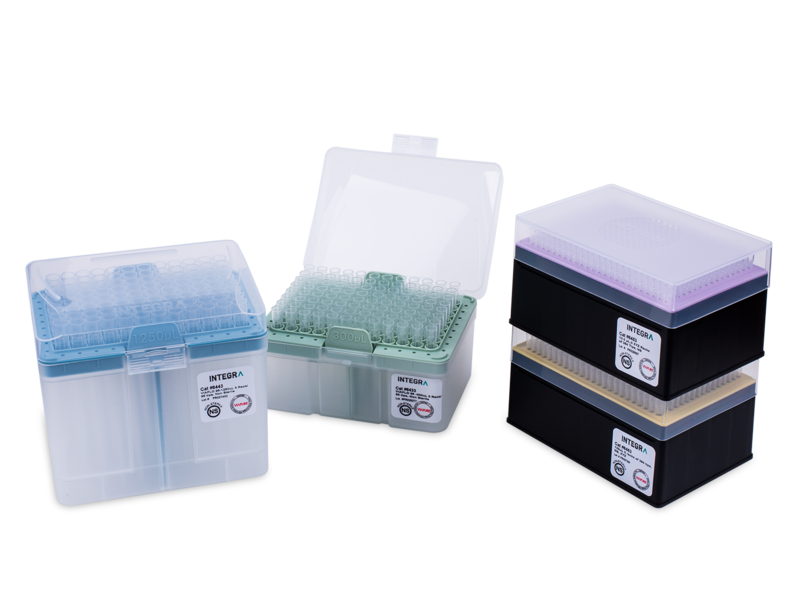
INTEGRA has developed the ASSIST PLUS pipetting robot to streamline routine pipetting tasks at an affordable price. Using INTEGRA electronic multichannel pipettes, the system:
- automates pipetting tasks,
- eliminates physical strain and
- ensures superior reproducibility and
- error free pipetting.
Part No. 4505
Download
Download App Note as PDF
DownloadEasy 2-step sample preparation for LC-MS analysis on the ASSIST PLUS pipetting robot
Customer’s voice
Implementing this liquid handler in our molecular workflow has cut production time dramatically with the ease and reproducibility this instrument offers. Prep can be done in half the time and supports new lab personnel carry out multiple steps in our workflow with accuracy and confidence. The flexibility of the unit is also incredible with the ability to edit programs in real time or on the pc, reassign pipettes to base units freely as workflows require. This liquid handler is a staple in our laboratory.
Related products

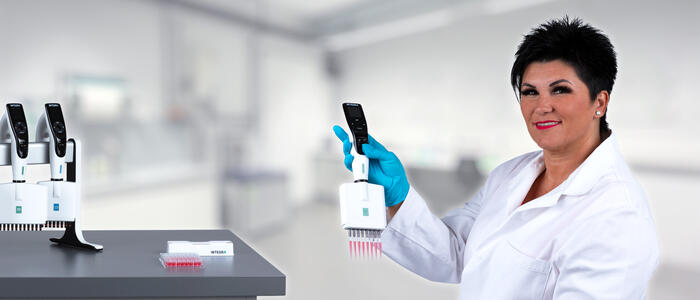
Applications
Show all-
End-to-end Twist library preparation protocol for NGS workflow automation
-
A simple and streamlined workflow for membrane protein isolation
-
Streamlining single-cell sequencing with the Flex Apex workflow using automated liquid handling solutions
-
Optimizing DNA fragmentation and NGS library preparation with automated liquid handling
Stories
Show all-
 · Company News
Streamlining CRISPR workflows, from editing to analysis
-
 · Customer Testimonial
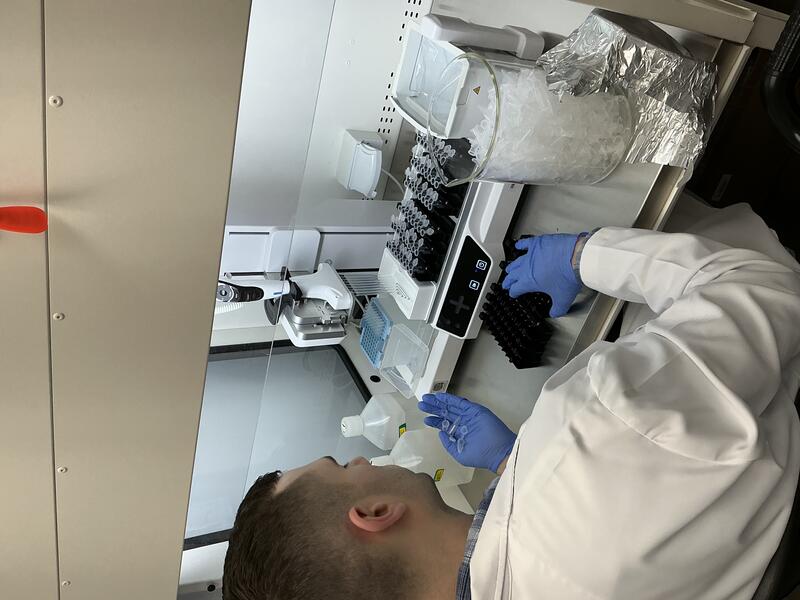
Enhancing the consistency of ag-tech R&D processes with the ASSIST PLUS pipetting robot
-
 · Product News
Magnetic beads represent a modern approach to gDNA isolation
-
 · Product News
Magnetic beads for NGS size selection and PCR purification