


-
Semi-automated medium exchange in Akura™ 96 and 384 Spheroid Microplates with the VIAFLO 96 and VIAFLO 384
Efficient and precise liquid handling protocol with the VIAFLO 96 and VIAFLO 384
3D human in vitro cell models are gaining increased importance in the drug discovery and development cycle of the pharmaceutical industry as they mimic the human in vivo responses of newly developed substances more precisely than 2D models. They can help to bridge the gap between the traditional 2D in vitro models and whole-animal systems as the traditional models do not effectively recapitulate the more complex signalling and cellular interactions found in vivo. Spheroids are scaffold-free 3D cell culture models that are aggregated from one or more organ-specific cell types.
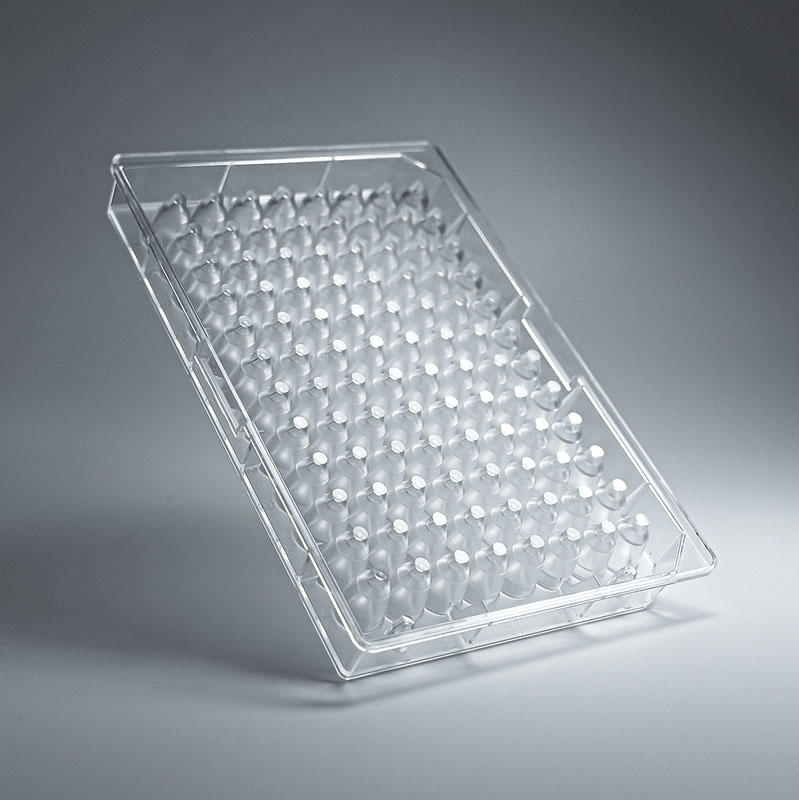
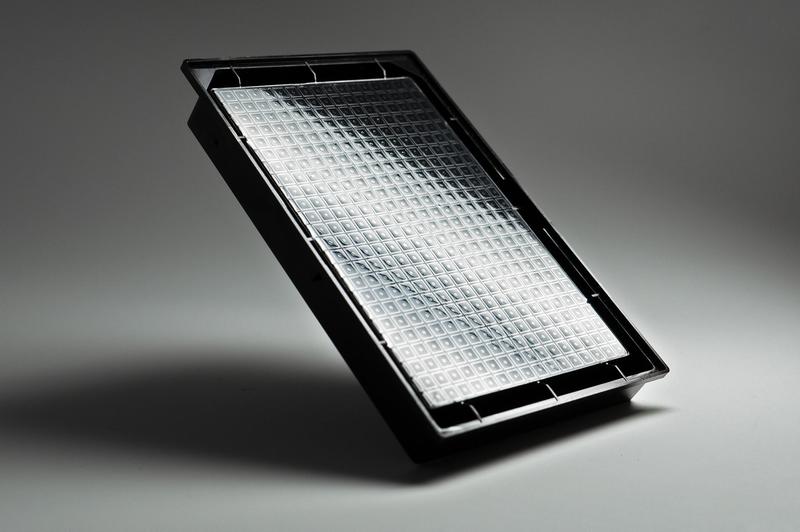
InSphero has developed 3D cell-based assay solutions in the fields of liver toxicology, metabolic diseases, and oncology. Industrial use of these complex in vitro systems requires a perfect match of the tissue model, cell culture plates and liquid handling instrumentation. InSphero’s Akura™ 96 and 384 Spheroid Microplates have been engineered for the generation, long-term cultivation, observation and testing of spheroids in 96 and 384 well formats in a simple, flexible, and automation-compatible platform. Its scalable format requires liquid handling systems for convenient, yet quick, reliable, and precise medium exchange, sampling, dosing, and spheroid transfer from multiple plates. The semi-automated VIAFLO 96 and VIAFLO 384 electronic pipettes are ideal for these routine lab tasks, offering 96 and 384 channel pipetting in a compact and easy-to-use platform, for increased productivity.
-
Table of contents
3D human in vitro cell models are gaining increased importance in the drug discovery and development cycle of the pharmaceutical industry as they mimic the human in vivo responses of newly developed substances more precisely than 2D models. They can help to bridge the gap between the traditional 2D in vitro models and whole-animal systems as the traditional models do not effectively recapitulate the more complex signalling and cellular interactions found in vivo. Spheroids are scaffold-free 3D cell culture models that are aggregated from one or more organ-specific cell types.
InSphero has developed 3D cell-based assay solutions in the fields of liver toxicology, metabolic diseases, and oncology. Industrial use of these complex in vitro systems requires a perfect match of the tissue model, cell culture plates and liquid handling instrumentation. InSphero’s Akura™ 96 and 384 Spheroid Microplates have been engineered for the generation, long-term cultivation, observation and testing of spheroids in 96 and 384 well formats in a simple, flexible, and automation-compatible platform. Its scalable format requires liquid handling systems for convenient, yet quick, reliable, and precise medium exchange, sampling, dosing, and spheroid transfer from multiple plates. The semi-automated VIAFLO 96 and VIAFLO 384 electronic pipettes are ideal for these routine lab tasks, offering 96 and 384 channel pipetting in a compact and easy-to-use platform, for increased productivity.
Key benefits
Overview: How to perform medium exchange in Akura 96 and 384 Spheroid Microplates with VIAFLO 96 and VIAFLO 384
Experimental set-up
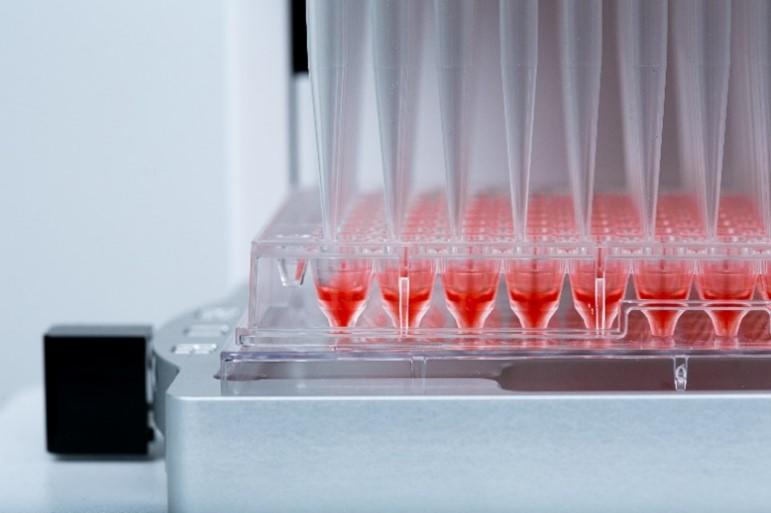
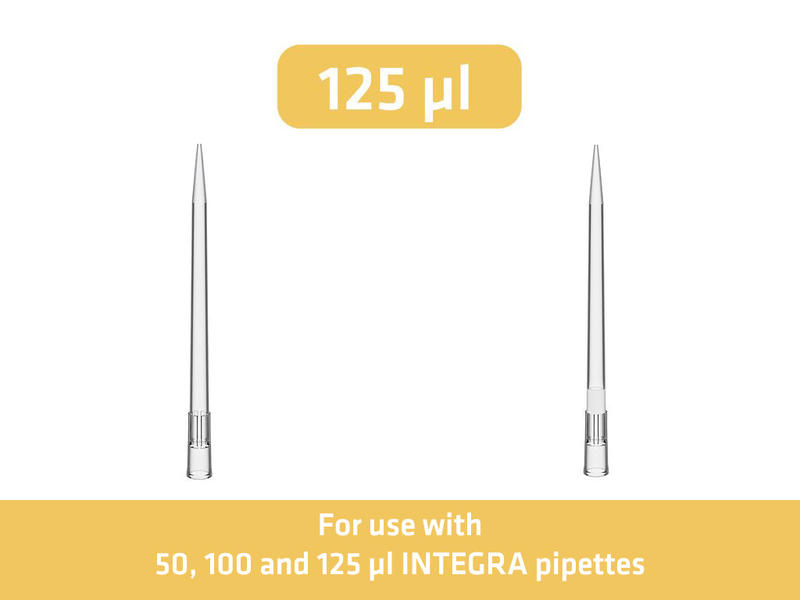
The VIAFLO 96 and VIAFLO 384 are used for medium exchange in Akura 96 and 384 plates. The liquid handling steps are optimized to ensure there is no spheroid loss. The VIAFLO 96 is equipped with a 96 channel pipetting head (10-300 µl) and both spring loaded and standard plate holders. 300 µl Sterile, Filter GRIPTIPS® are used. The spheroids are cultured in Akura 96 plates with 70 µl of medium. The VIAFLO 384 is set up with a 384 channel pipetting head (5-125 µl) and both spring loaded and standard plate holders. 125 µl Sterile, Filter GRIPTIPS are used. Spheroids are cultured in Akura 384 plates with 50 µl of medium. Customized VIALINK programs are provided for every step of the protocol.
Downloads: App note and protocols for the Akura™ 96 and 384 Spheroid Microplates with the VIAFLO 96 and VIAFLO 384
Here you can download the complete protocols used in this application and use them on your VIAFLO 96 and VIAFLO 384. The protocol can be modified and transferred directly to the pipette with the VIALINK software.
Step-by-step procedure
Overview of the process:
- Program 1: Medium aspiration – Akura 96
- Program 2: Medium dispensing – Akura 96
- Program 3: Medium aspiration – Akura 384
- Program 4: Medium dispensing – Akura 384
1. Medium aspiration – Akura 96
Medium is aspirated from four Akura 96 plates and discarded or sampled
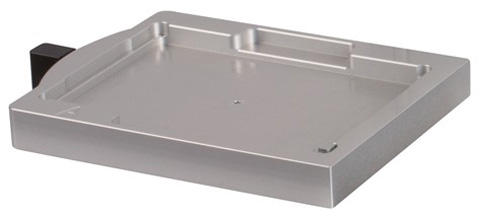
Load 300 µl Sterile, Filter GRIPTIPS onto the VIAFLO 96. Place a 300 ml automation friendly reagent reservoir on position B. Place an Akura 96 lid with the opening facing down on position A. When fixing the lid in position, make sure that its orientation notch does not face the spring of the plate holder (see video 1). Place the Akura 96 plate containing the spheroids onto the lid (see video 1). This allows the plate position to be manually adjusted to create a small horizontal offset (1-2 mm) with respect to the tips (Figure 1a and Figure 2). This ensures that the pipette tips are positioned on the SureXchange ledge of the well, preventing unintended aspiration of spheroids.
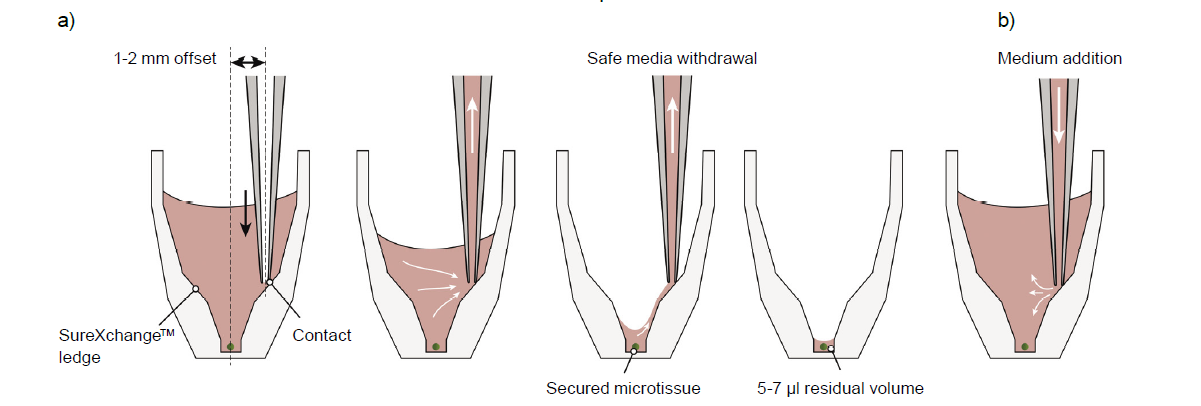
Select the custom program 'M_ASP_96_MAN'. The pipette aspirates 75 µl of medium at speed 1. This low speed minimizes the shearing force that the spheroid could be subjected to. The aspiration volume is set higher than the volume of the well (70 µl) to ensure complete removal of the medium. The special design of the well protects the spheroids and leaves a defined residual volume of 5-7 µl. This step is repeated 3 times, changing the plate containing the spheroids in between each step. When the last aspiration step is finished, move the pipette head to position B. A prompt on the pipette screen informs the user that the medium needs to be purged to the waste reservoir or into a collection plate. The purge step is performed with speed 8. Eject and discard the tips afterwards. The last step in the program is a loop, which means that the 4 aspiration steps and the final purging step are repeated up to 100 times, allowing processing of up to 400 plates. Abort the program once all the plates have been processed.
If the medium is intended to be sampled for downstream analysis, it must be dispensed after each aspiration step into a respective sampling plate.
Tips:
- Use Sterile, Filter GRIPTIPS for contamination-free processing.
- The Run button is pressed twice to purge the liquid when waste disposal is required. This warning step supports the user and makes sure that the waste is not dispensed back into the wells and is an important feature when exchanging the medium on several plates at once.
2. Medium dispensing – Akura 96
Fresh medium is dispensed into the wells of four Akura 96 plates from the reservoir
Discard the used tips and load new 300 µl Sterile, Filter GRIPTIPS onto the VIAFLO 96. Place an automation friendly reagent reservoir with fresh medium on position B. Allow up to 10 ml of extra medium to prevent aspiration of air.
Place an Akura 96 plate onto an Akura 96 lid in position A. Adjust the plate manually to create a small horizontal offset (1-2 mm). Select and run the custom program 'M_DISP_96_MAN'. Move the pipette head to the reservoir on position B. The pipette aspirates 290 µl of fresh medium, which is sufficient to fill four plates with 70 µl medium plus 10 µl of excess volume. Move the pipette head to position A and gently immerse the pipette tips into the wells of the Akura 96 plate until the minimum height is reached (Figure 1b). The pipette dispenses 70 µl medium into each well at a slow speed. The dispensing step is repeated 3 times, changing the plate after each step. The pipette will prompt the user to purge the medium that remains in the tip. The aspiration and dispensing process of four plates is repeated up to 100 times due to a loop at the end of the program.
Tip:
- Low pipetting speed can be set up in the VIALINK program to avoid damaging the delicate spheroids.
3. Medium aspiration – Akura 384
Medium is aspirated from one or more Akura 384 plates and discarded or sampled
Load 125 µl Sterile, Filter GRIPTIPS on the VIAFLO 384. Place an empty 300 ml automation friendly reagent reservoir on position B.
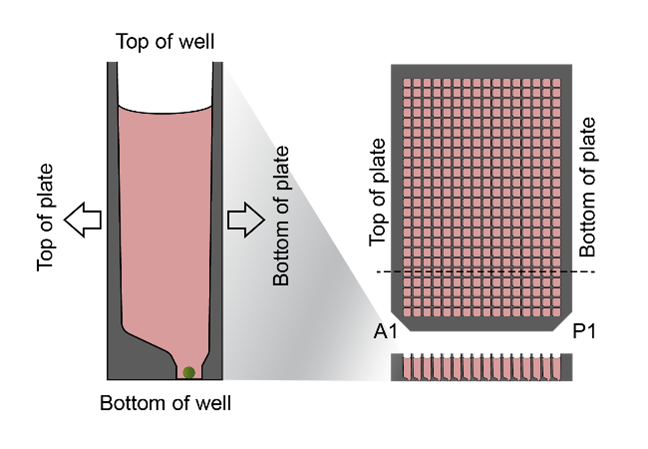
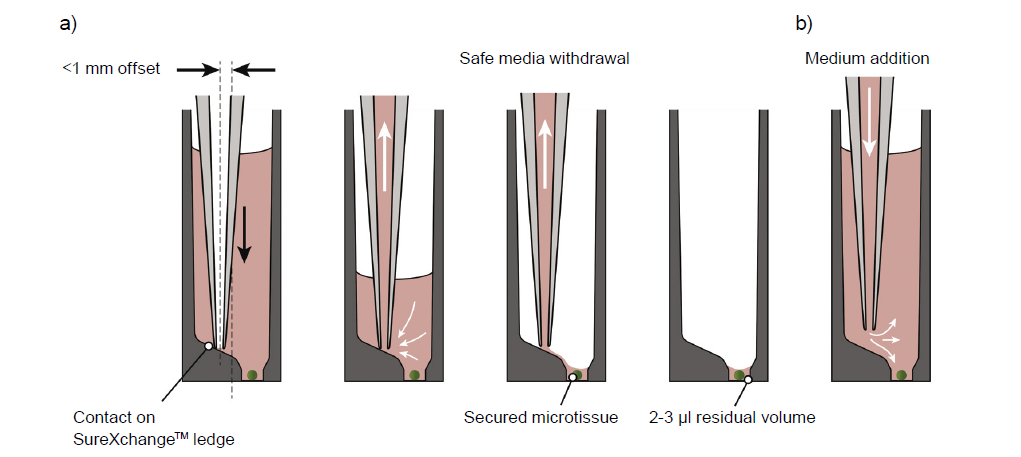
Place an Akura 384 lid with the opening facing down on position A. To fixing the lid in position, make sure that the orientation notch of the lid does not face the spring of the plate holder (see video 2). Place the Akura 384 plate containing the spheroids onto the lid (see video 2). This allows the plate to be manually adjusted towards the user (‘Bottom of plate’, Figure 3), creating a small horizontal offset (1-2 mm) with respect to the tips. This ensures that the pipette tips are positioned on the SureXchange ledge of the well, preventing unintended aspiration of spheroids (Figure 4a).
Select the custom program 'M_ASP_384_MAN'. The pipette aspirates 70 µl at speed 1. This low speed minimizes the shearing force that the spheroid could be subjected to. The aspiration volume is set higher than the volume of the well (50 µl) to ensure complete removal of the medium. The special design of the well protects the spheroids and leaves a defined residual volume of 2-3 µl. A prompt on the pipette screen informs the user that the medium needs to be purged to the waste reservoir or into a collection plate. The last step in the program is a loop, which means that the required pipetting steps can be easily repeated for multiple plates without the need to restart the program. Abort the program, eject, and discard the tips once all the plates have been processed.
4. Medium dispensing – Akura 384
Fresh medium is dispensed into two Akura 384 plates from the reservoir
Discard the used tips and load new 125 µl Sterile, Filter GRIPTIPS onto the VIAFLO 384. Place an automation friendly reagent reservoir with fresh medium on position B. Allow up to 10 ml of extra medium to prevent aspiration of air.
Place an Akura 384 plate onto an Akura 384 lid in position A. Adjust the plate manually towards the user (‘Bottom of plate’) to create a small horizontal offset (1-2 mm). Select and run the custom program 'M_DISP_384_MAN'. Move the pipette head to the reservoir on position B. The pipette aspirates 110 µl fresh medium, which is sufficient to fill two plates with 50 µl medium plus 10 µl of excess volume. Move the pipette head to position A and gently immerse the pipette tips into the wells of the Akura 384 plate until the minimum height is reached (Figure 4b). The pipette dispenses 50 µl medium into each well at slow speed. The dispensing step is repeated once more for a second well plate. The pipette will prompt the user to purge the medium that is remaining in the tip. The dispensing process for two plates is repeated up to 100 times due to a loop at the end of the program.
Tip:
- Z heights may vary from system to system, depending on the calibration. Check the correct height using a dummy plate. Pipette tips need to be positioned 0.2-0.3 mm above the spheroid. Lower pipette positioning could damage the spheroids.
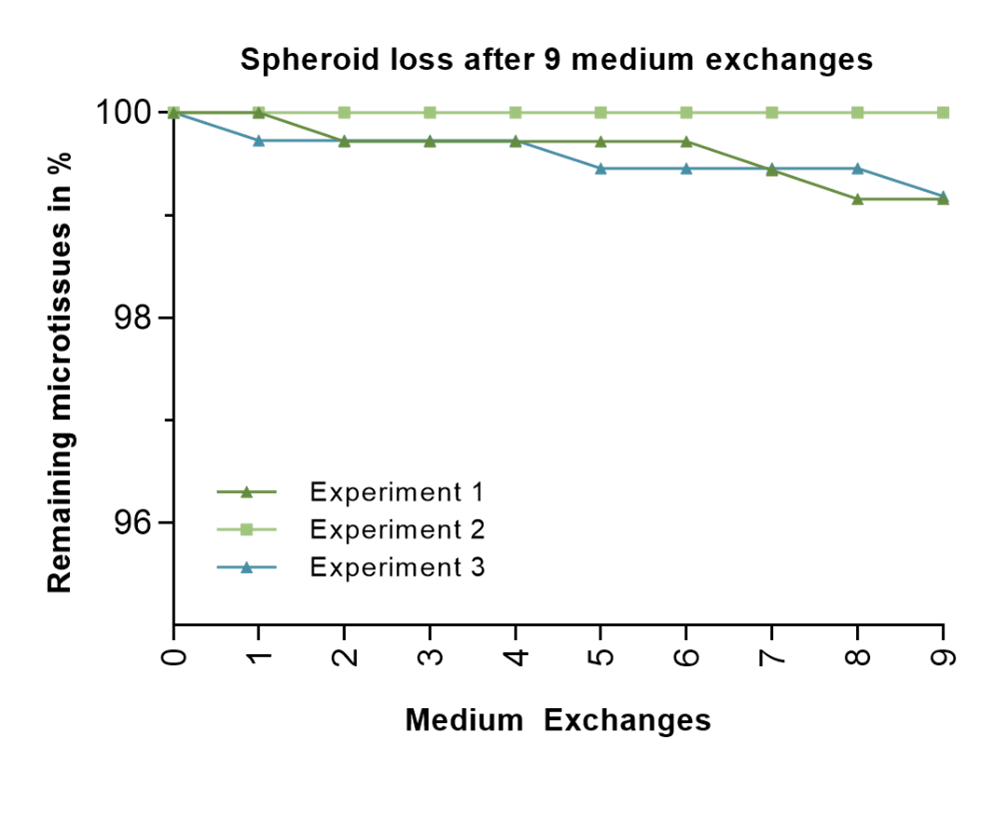
Three independent experiments showed <1 % spheroid loss from Akura 384 plates during nine consecutive medium exchanges (Figure 5).
Remarks
- Partial plates: Programs can be adapted to a different number of samples at any time, giving laboratories total flexibility to meet current and future demands.
- Automatic mode: The VIAFLO 96 and VIAFLO 384 handheld electronic pipettes can operate in an automatic mode, ensuring that all the liquid handling steps are performed in the same way. The customized automatic programs can be found in the download section. IMPORTANT: When using the automatic programs there is no need to place the lid below the Akura 96 and 384 plates.
- Spheroid collection and transfer: The special coating of the Akura plates prevents adherence of the spheroids to the bottom of the well. This aids the collection of microtissues for transfer into another plate format, or for further processing. The customized program for spheroid collection and transfer (TRANS_TO_384) is available in the download section.
Conclusion
Ask our expert. Leave a comment!
Write us if you have any questions regarding the application note or one of our instruments.
Any questions? I'm happy to help!
Instruments and accessories
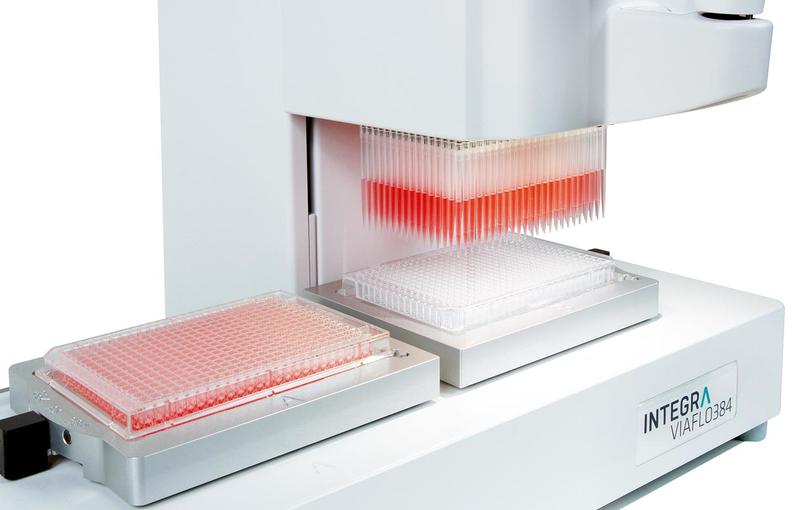
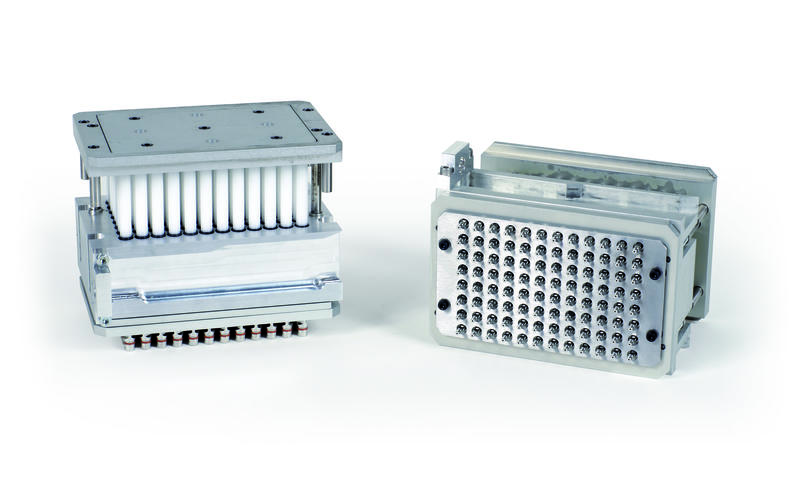
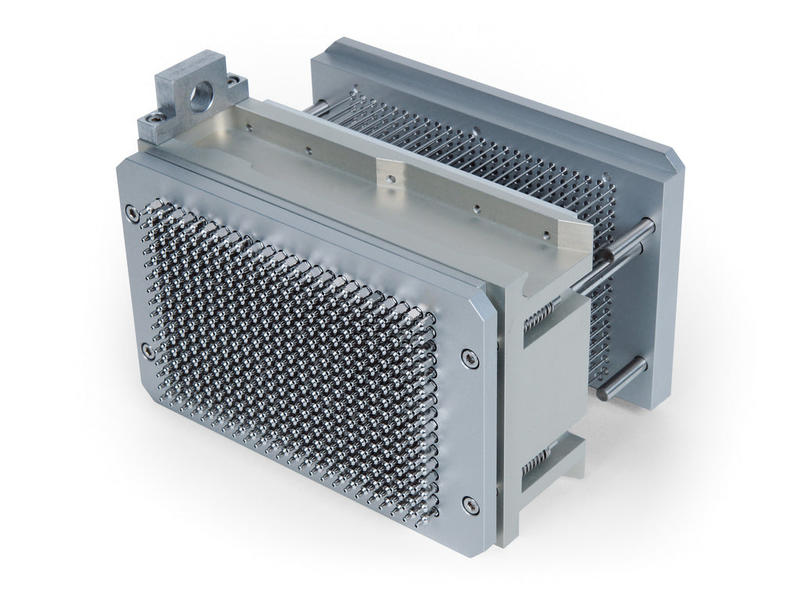
VIAFLO 96/ VIAFLO 384, Handheld Electronic Pipette
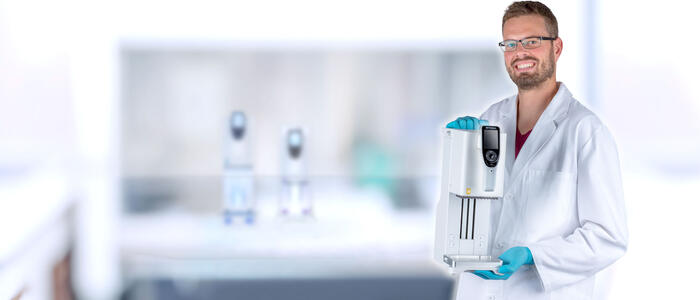
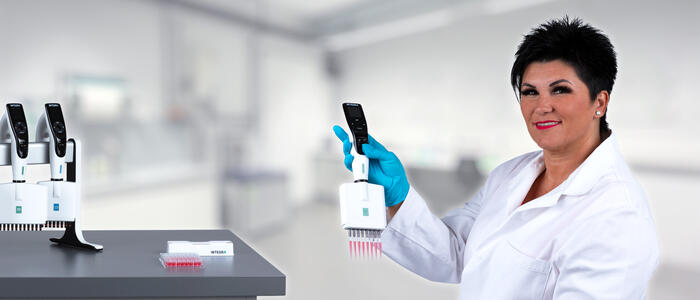
With this 24, 96 and 384 channel pipette, INTEGRA meets the need for an affordable, compact and easy to use pipette that provides increased productivity. The unique operating concept makes VIAFLO 96/384 as easy to use as any traditional handheld pipette.
Part No. 6001 / 6031
Download
Download App Note as PDF
DownloadSemi-automated medium exchange in Akura™ 96 and 384 Spheroid Microplates with the VIAFLO 96 and VIAFLO 384
Customer’s voice
The Viaflo 96/384 let us for faster plate operation in medium-throughput applications. Especially important is the programming of the positions in space for precise pipetting in desired position of the well.
Related products

Applications
Show all-
Enhanced workflow for high throughput, high density microelectrode array (HD-MEA) electrophysiology on MaxTwo 24-Well Plates
-
Automating media exchange and sample collection using Ronawk’s Bio-Blocks® In Similare technology and the ASSIST PLUS
-
Automating the Corning Matrigel® thin coating protocol for cell culture applications
-
Automation-enabled high throughput electroporation of primary cells using the ASSIST PLUS and DropGenie platform
Stories
Show all-
 · Customer Testimonial
Optimizing respiratory virus research workflows with VACUBOY
-
 · Customer Testimonial
Setting a new benchmark in efficient cell culture with the PIPETBOY GENIUS
-
 · Customer Testimonial
Exploring new treatment pathways in pediatric oncology
-
 · Customer Testimonial
Pioneering immune sensing and signaling dynamics research