


Reproducible detection assays with the ASSIST PLUS pipetting robot
The Hadad Research Group, based within the Department of Chemistry and Biochemistry at the Ohio State University, focuses on studying organophosphate pesticides in vitro. Stacey Allen, a graduate student in the lab, explained: “We are working on developing treatments to reverse the acetylcholinesterase inhibition caused by pesticides or nerve agents, as well as new ways of protecting people against exposure to these chemicals. We mainly focus on structure-activity relationships, looking at, for instance, the effect of tweaking one part of a compound on its ability to restore enzyme activity. Our main goal is to generate some good ‘hits’ using these in vitro techniques, which can then be used in in vivo studies to further understanding of, for example, how these compounds cross the blood brain barrier.”
Automating various workflows
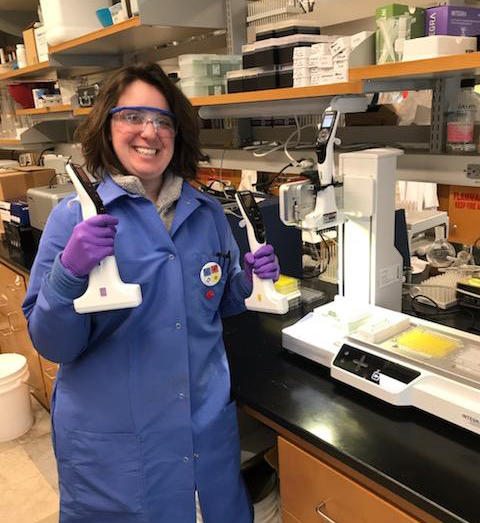
The group acquired an ASSIST PLUS pipetting robot in March 2019, after an evaluation of their work processes proved that it was needed. Stacey continued: “We mainly use the ASSIST PLUS to automate the process of preparing our plates for incubation, pipetting all of our negative controls and a variety of compounds into the plates and then performing a mixing step. We also use the robot for our detection assays – such as the Ellman’s assay – where we use it to pipette samples out of the incubated plate and into another, before they are put in a plate reader.”
“We were originally doing everything manually, but it was exhausting, and the risk of developing repetitive strain injuries was high. Not only that, but there was quite a lot of human error and variation in results, especially between different operators. We put a lot of thought into what functionality we needed, and the ASSIST PLUS met all of our requirements, and was reasonably priced compared to other liquid handling platforms. The fact that we can switch out different pipettes on this system, and use them for manual pipetting when needed, is also really beneficial. We chose to use the VOYAGER adjustable tip spacing pipettes with our robot because they make transferring samples between different labware formats – such as tubes to plates – much easier.”
Intuitive to program
The combination of the ASSIST PLUS with the VIALAB pipetting software makes it simple to create automated protocols for a range of applications, without the need for advanced programming expertise. Stacey added: “It’s so easy to train people to use the robot, whether they are undergraduate students or graduates, and the software is very user friendly and intuitive – nobody had to train me to use it, I just sat down one day and figured it out for myself. If you need to edit a workflow, each step has a description, so it really clearly explains what everything does and makes it so simple to customize your programs. You can even perform a final check of your program using the simulation feature, which is great to ensure that you’ve got everything right before putting it into practice.”
Perfect connection
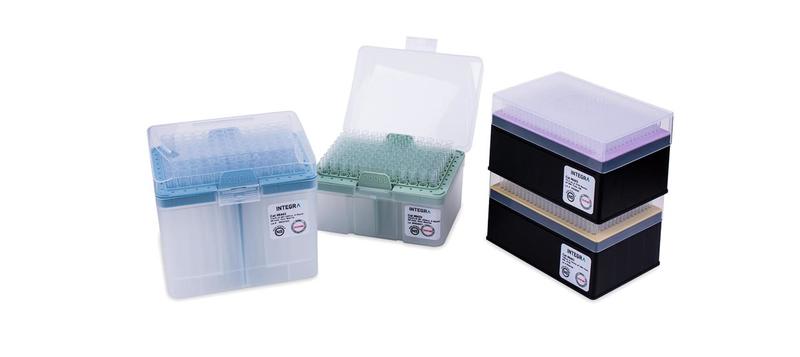
INTEGRA’s range of GripTip pipette tips are designed to suit a variety of workflows, and tips that are suitable for benchtop pipetting platforms – such as the ASSIST PLUS – undergo additional quality control procedures, including a secondary straightness test. This helps to guarantee perfect targeting of wells for automatic pipetting. Stacey commented: “We mainly use the low retention, non-sterile tips. The tips easily attach to the VOYAGER, both when we are using it manually and when it is mounted on the ASSIST PLUS.”
Expanding programs
“Although we use many of the same volumes and pipetting methods currently, we are starting to look at adding a range of different detection methods to our workflow, and to automate them using the robot. This will require us to write new programs, and it’s really useful that we can save up to 200 programs on the VOYAGER pipettes to have at our fingertips. Overall, the ASSIST PLUS has been great for our work – our results are much more reproducible, errors are less frequent and it saves us a lot of time. We’re now looking at getting another one because so many people are using it” concluded Stacey.
Applications
Show all-
End-to-end Twist library preparation protocol for NGS workflow automation
-
A simple and streamlined workflow for membrane protein isolation
-
Streamlining single-cell sequencing with the Flex Apex workflow using automated liquid handling solutions
-
Optimizing DNA fragmentation and NGS library preparation with automated liquid handling
Stories
Show all-
 · Company News
Streamlining CRISPR workflows, from editing to analysis
-
 · Customer Testimonial
Enhancing the consistency of ag-tech R&D processes with the ASSIST PLUS pipetting robot
-
 · Product News
Magnetic beads represent a modern approach to gDNA isolation
-
 · Product News
Magnetic beads for NGS size selection and PCR purification