









-
Performing an ELISA with the VIAFLO 96/384 handheld electronic pipette
Enzyme-linked immunosorbent assays with VIAFLO 96/384 handheld electronic pipette
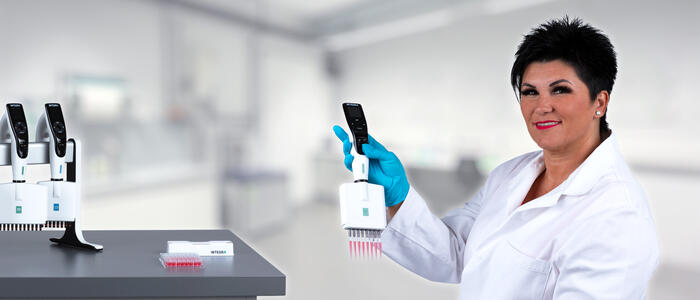
ELISA (enzyme-linked immunosorbent assay) is a plate-based assay that is commonly used to quantify and detect peptides, proteins, antibodies or hormones. Well to well and plate to plate consistency and reproducibility are key success factors for ELISAs, which consist of multiple pipetting steps that are time-consuming and tedious to perform manually. Using the VIAFLO 96/384 handheld electronic pipette can vastly improve ELISAs. The 96 channel pipetting head makes the whole process faster, less error prone and much more reproducible compared to traditional single or multichannel pipettes by transferring the samples and reagents into all 96 wells of the plate at the same time. The VIAFLO 96/384 electronic pipette offers clear gains in productivity, consistency and reproducibility while remaining as easy to use as a traditional handheld pipette.
-
Table of contents
ELISA (enzyme-linked immunosorbent assay) is a plate-based assay that is commonly used to quantify and detect peptides, proteins, antibodies or hormones. Well to well and plate to plate consistency and reproducibility are key success factors for ELISAs, which consist of multiple pipetting steps that are time-consuming and tedious to perform manually. Using the VIAFLO 96/384 handheld electronic pipette can vastly improve ELISAs. The 96 channel pipetting head makes the whole process faster, less error prone and much more reproducible compared to traditional single or multichannel pipettes by transferring the samples and reagents into all 96 wells of the plate at the same time. The VIAFLO 96/384 electronic pipette offers clear gains in productivity, consistency and reproducibility while remaining as easy to use as a traditional handheld pipette.
Key benefits
Overview of the sandwich ELISA steps and corresponding programs:
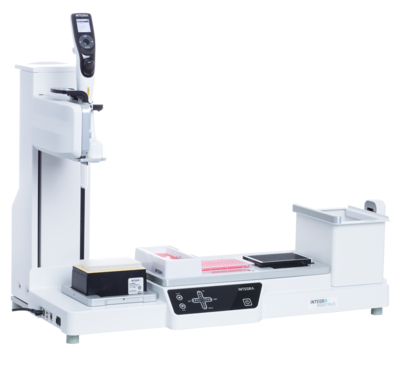
The following protocol shows an example set-up for performing a sandwich ELISA using the VIAFLO 96/384 handheld electronic pipette together with a three position stage. In this protocol, position A is dedicated to the GRIPTIP® box and the liquid waste reservoir, position AB to reagent reservoirs containing the various reagents and washing solutions required, and position B to the ELISA plate. A 96 channel pipetting head (10-300 μl) is used together with 300 μl Sterile, Filter, Low Retention GRIPTIPS. Customized VIALINK programs are provided for performing a sandwich ELISA with the VIAFLO 96/384.
Note: The VIALINK programs provided can be easily adapted to any other ELISA type, e.g. direct, indirect or competitive ELISAs, by just adding or removing steps from the protocols supplied.
Downloads: Protocols for automated ELISA with VIAFLO 96/384
Here you can download the complete protocols used in this application and use them on your VIAFLO 96/384. The protocol can be customized with the VIALINK software.
Step-by-step procedure
1. Coat the ELISA plate
Adding the capture antibody to coat the ELISA plate.
Place the capture antibody, prediluted in the coating buffer, into a 150 ml automation friendly reagent reservoir. Select and run the VIALINK E_REAGENTS program, then simply follow the instructions on the pipette. Pipette 100 μl of the capture antibody into the ELISA plate and then incubate it.
Tips: A z-height limit is defined to ensure an optimal tip immersion depth, preventing both air entering into the tips during the aspiration step and the pipette tips from touching the bottom of the plate. We also recommend setting the Tip Align support strength to 3 for this application. To increase your throughput, the Repeat Dispense mode of the VIAFLO 96/384 electronic pipette can be used to rapidly prepare several plates at once. The VIALINK program E_REAGENTS_3 PL is an example of a multiple plate filling protocol.
2. Block the plate
Blocking the ELISA plate’s non-specific binding sites.
Select the VIALINK program E_REAGENTS to remove the coating buffer from the plate, then use the E_WASH program to wash the plate three times with 200 μl of washing buffer from a 300 ml automation friendly reagent reservoir. Firmly blot the plate against clean paper towels. To block the ELISA plate, select the corresponding E_BLOCK program and transfer 300 μl of the blocking buffer from a 150 ml automation friendly reservoir into the plate before incubation.
Tips: All wells are treated simultaneously and in the same way. This ensures not only the well to well consistency of the assay, but also the reproducibility from plate to plate. The z-height is set 1 mm above the bottom of the plate, preventing the tips from scratching the coated surface, which can lead to inaccurate or inconsistent assay results.
3. Add the controls and samples
Adding the diluted samples and controls to the ELISA plate.
Select and run the E_BLOCK program to remove the blocking buffer, then wash the plate using the E_WASH program. In the current example, the controls and samples are dispensed into a 96 well plate. The E_REAGENTS program allows rapid, simultaneous transfer of all samples and controls into the ELISA plate before incubation.
Tips: Adding all the samples at once ensures optimal productivity and reproducibility of the ELISA. If your samples are stored in microcentrifuge tubes, using a VOYAGER 8 channel 300 μl adjustable tip spacing pipette allows you to quickly reformat them from the tubes to the plate at the simple touch of a button, while reducing transcription errors when compared to a single channel pipette. ELISA buffers often contain surfactants, such as Tween 20. Using Low Retention GRIPTIPS reduces the residual volume in the tips for maximum sample recovery.
4. Add the detection antibody
Adding the diluted detection antibody to the ELISA plate.
After incubation, select the E_REAGENTS program to remove the sample buffer, then use E_WASH to wash the plate three times. Place the detection antibody into a 150 ml automation friendly reagent reservoir on position AB. Run the E_REAGENTS program to rapidly transfer the detection antibody into the ELISA plate before incubation.
5. Add the enzyme conjugate
Adding the enzyme conjugate to the ELISA plate.
Repeat step 4 to add the enzyme conjugate. Incubate the plate.
6. Add the substrate
Adding the TMB substrate and incubating the plate until the color develops sufficiently.
Remove the buffer then thoroughly wash the plate six times before adding 100 µl of TMB substrate to the ELISA plate. Incubate the plate at room temperature: the color of the solution changes from transparent to blue in wells where the samples have reacted with the antibodies. The color intensity depends on the sample concentration.
7. Stop the reaction
Adding the stop solution to the plate before detection.
Use the VIALINK E_REAGENTS program to add the stop solution to the plate; the color changes from blue to yellow in wells where the samples have reacted with the antibodies. The plate is now ready for detection.
Remarks
Partial plate
If your particular ELISA doesn't require processing of 96 samples, the VIAFLO 96/384 is able to work with any number of tips loaded, giving you the benefit of simultaneous and precise dispensing of a smaller number of samples.
Automation
The instrument can also operate on its own, reducing user interaction, which in turn improves ergonomics and reproducibility. This also makes the VIAFLO 96/384 ideal for use in tight spaces, such as under a laminar flow cabinet
Conclusion
Further reading
Ask our expert. Leave a comment!
Write us if you have any questions regarding the application note or one of our instruments.
Any questions? I'm happy to help!
Instruments and accessories
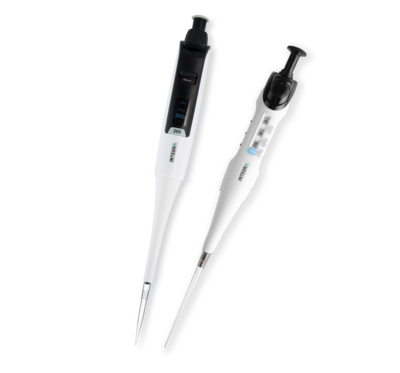
VIAFLO 96/ VIAFLO 384, Handheld Electronic Pipette
With this 24, 96 and 384 channel pipette, INTEGRA meets the need for an affordable, compact and easy to use pipette that provides increased productivity. The unique operating concept makes VIAFLO 96/384 as easy to use as any traditional handheld pipette.
Part No. 6001 / 6031
Download
Download this App Note as PDF file
DownloadPerforming an ELISA with the VIAFLO 96/384 handheld electronic pipette
Customer’s voice
We just received our second ViaFlo 96 pipettor with a 1250 µL head and unexpectedly, and immediately, put it to use washing ELISA plates with minimum wash buffer dead volume. We were changing pipetting heads three and four times a day on one instrument between our 12.5 µL, 50 µL and 300 µL 96-well heads. We now spend less time changing heads as well with the second pipettor. The simple things that make for a happy lab.
Related products
Applications
Show allStories
Show all-
· Product NewsHow to save time and elevate your ELISA workflows
-
· Customer Testimonial“How did we manage without a 96-channel pipette?”
-
· Customer TestimonialVOYAGER adjustable tip spacing pipette accelerates immunology research at University of Basel
-
· Customer TestimonialStreamlining hepatitis C vaccine research using VIAFLO pipettes
-
· Product NewsMagnetic beads for NGS size selection and PCR purification
-
· Customer TestimonialQIAGEN is accelerating PCR sample prep with our flexible pipetting solutions
-
· Product NewsErgonomic pipettes and pipetting guidelines