-
Measuring dead volume in INTEGRA’s multichannel reagent reservoirs
Save on expensive reagents and precious samples by using low dead volume multichannel and divided reagent reservoirs
As miniaturization and high throughput processing increase in popularity, the required reagent volumes for lab assays decrease while their value increases. This is particularly true of expensive Master Mix, enzymes, self-expressed antibodies and new compounds. Any loss of reagent due to a high dead volume is unacceptable, yet this is a reality that many researchers face on a daily basis when using a multichannel pipette to transfer a reagent from a reservoir into a multiwell plate. Most reagent reservoirs feature a V-shaped bottom to minimize dead volumes. However, as the liquid level lowers, the reagent starts to pool unevenly. As soon as a single pipette tip aspirates air, liquid transfer has to stop and the reagent remaining cannot be used for the defined application. This is known as the dead volume. INTEGRA developed a novel 25 ml divided reservoir to overcome this issue, which combines two innovative features: the SureFlo™ anti-sealing array and a unique surface treatment that spreads liquid evenly to offer even lower dead volumes. INTEGRA’s two-compartment reservoir enables the pipette tips to sit on the bottom and prevents liquids from pooling, offering the lowest dead volume on the market. This technical note provides experimental data to demonstrate this, and guidance to support users in setting up their experiments.
-
Table of contents
As miniaturization and high throughput processing increase in popularity, the required reagent volumes for lab assays decrease while their value increases. This is particularly true of expensive Master Mix, enzymes, self-expressed antibodies and new compounds. Any loss of reagent due to a high dead volume is unacceptable, yet this is a reality that many researchers face on a daily basis when using a multichannel pipette to transfer a reagent from a reservoir into a multiwell plate. Most reagent reservoirs feature a V-shaped bottom to minimize dead volumes. However, as the liquid level lowers, the reagent starts to pool unevenly. As soon as a single pipette tip aspirates air, liquid transfer has to stop and the reagent remaining cannot be used for the defined application. This is known as the dead volume. INTEGRA developed a novel 25 ml divided reservoir to overcome this issue, which combines two innovative features: the SureFlo™ anti-sealing array and a unique surface treatment that spreads liquid evenly to offer even lower dead volumes. INTEGRA’s two-compartment reservoir enables the pipette tips to sit on the bottom and prevents liquids from pooling, offering the lowest dead volume on the market. This technical note provides experimental data to demonstrate this, and guidance to support users in setting up their experiments.
The problem – dead volume
Dead volume refers to the volume of liquid that cannot be used for an application without the risk of aspirating air into the pipette tips. The dead volume depends on several factors: the material and geometry of the container; the nature and initial volume of the liquid; the number of pipetting channels and the tip spacing; and pipetting techniques and atmospheric conditions, for instance the air temperature and humidity, which impact surface tension. High reagent dead volume is a serious issue in laboratories, especially when pipetting precious liquids – such as Master Mix, enzymes or antibody solutions – into well plates using a multichannel pipette.
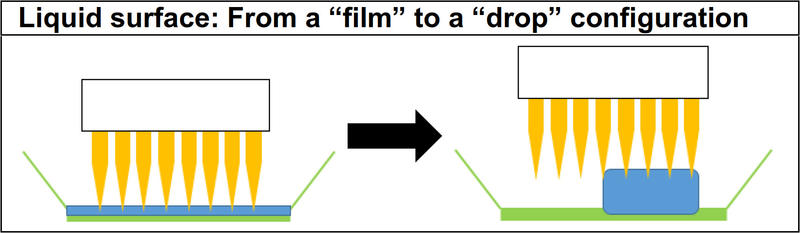
Traditional reservoirs have a V-shaped bottom to minimize dead volumes. However, as the liquid level lowers, the reagent starts to pool in multiple locations. As a result, a number of pipette tips may aspirate air (Figure 1).
To ensure there is adequate liquid to transfer, surplus reagent should be placed in the reservoir when setting up an experiment. The use of optimal reservoirs is a considerable asset for users, in order to reduce loss of precious reagents.
INTEGRA’s multichannel reagent reservoirs
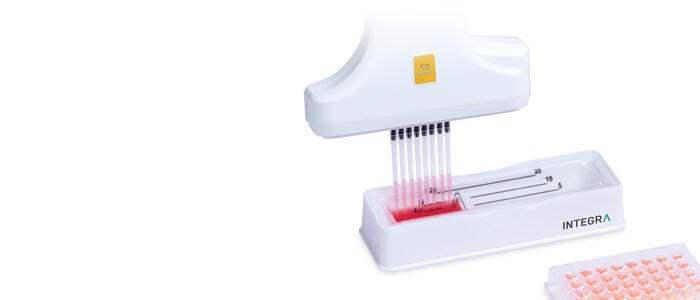
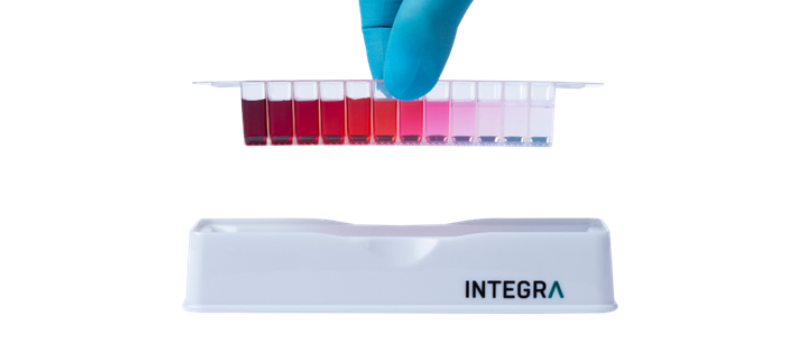
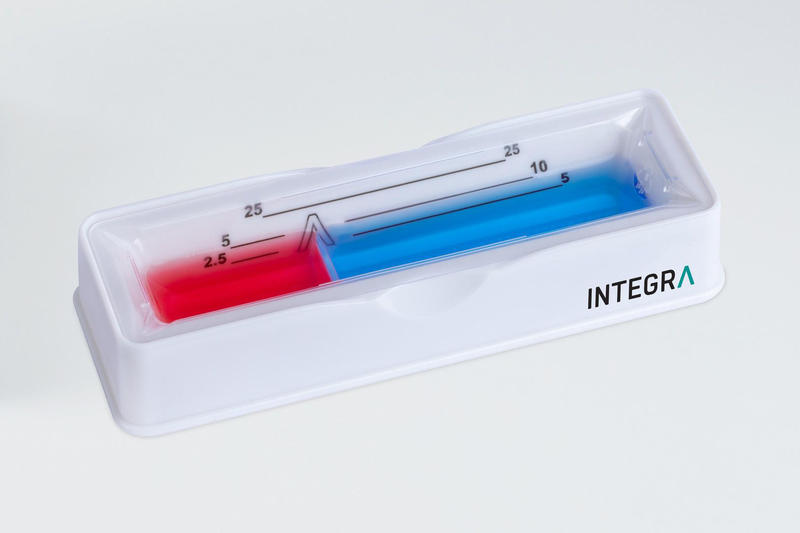
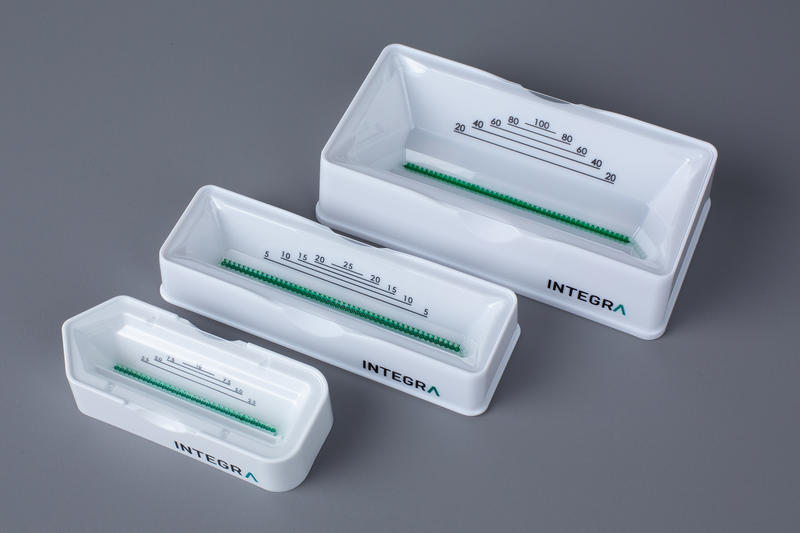
INTEGRA‘s multichannel reagent reservoirs consist of disposable inserts that fit into reusable bases with clearly visible volume markings. Inserts are available as crystal clear polystyrene (PS) reservoirs, or polypropylene (PP) for improved chemical compatibility. For maximum fluid recovery and minimal waste, INTEGRA reagent reservoirs feature a full length, extra deep trough that is more easily accessible for pipette tips.
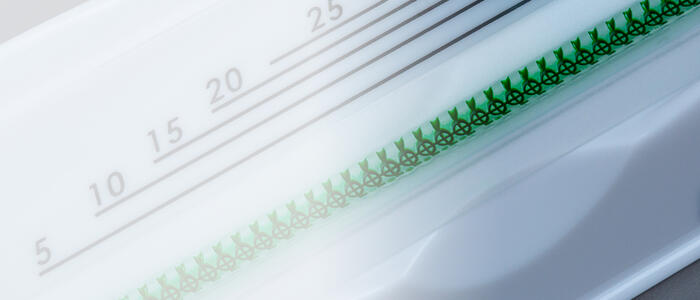
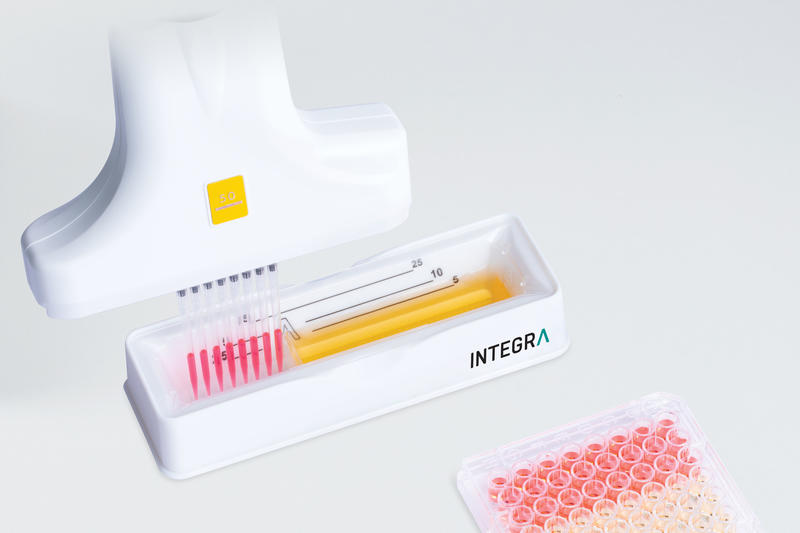
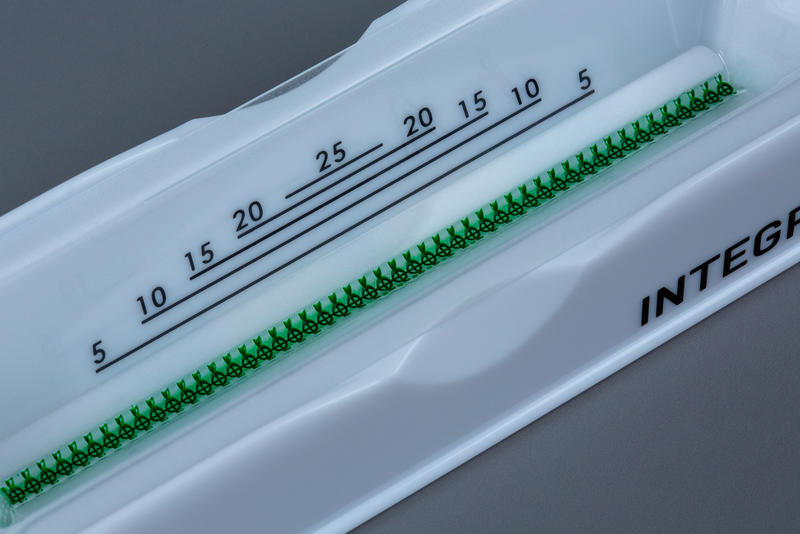
INTEGRA also developed a novel 25 ml divided multichannel reagent reservoir with a SureFlo anti-sealing array on the bottom and a unique surface treatment to further reduce dead volumes. The anti-sealing pattern consists of a series of small channels that allow the liquid to flow evenly across the bottom of the reservoir and prevent pipette tips from sealing. Pooling of liquid is prevented by a specially formulated, hydrophilic surface treatment. Additionally, the reservoir is divided, offering 5 and 10 ml volume compartments side by side, resulting in the lowest possible dead volume.
INTEGRA’s divided reservoirs are designed to be compatible with all VIAFLO fixed spacing and VOYAGER adjustable tip spacing multichannel pipettes.
Performance of INTEGRA’s reagent reservoirs
The main purpose of this technical note is to support users in setting up their experiments, helping them to maximize precious reagents. In a series of tests, we measured and compared the dead volumes in each INTEGRA multichannel reagent reservoir. The properties of water are strongly influenced by environmental factors – air temperature and humidity – in an uncontrolled lab environment and so we used a foaming blocking buffer containing diverse salts and low surface tension liquids in order to get closer to real lab conditions.
Standard multichannel reagent reservoirs
We measured the dead volume of INTEGRA’s standard polystyrene and 25 ml polypropylene reservoirs using a blocking buffer composed of 0.1 % Triton™ X- 100 and 0.05 % Tween 20® in a 1x TBS (0.05 M TRIS.HCl and 0.15 M NaCl in water ISO 3696:1995, grade 3).
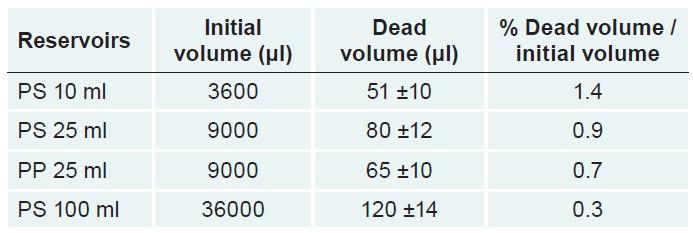
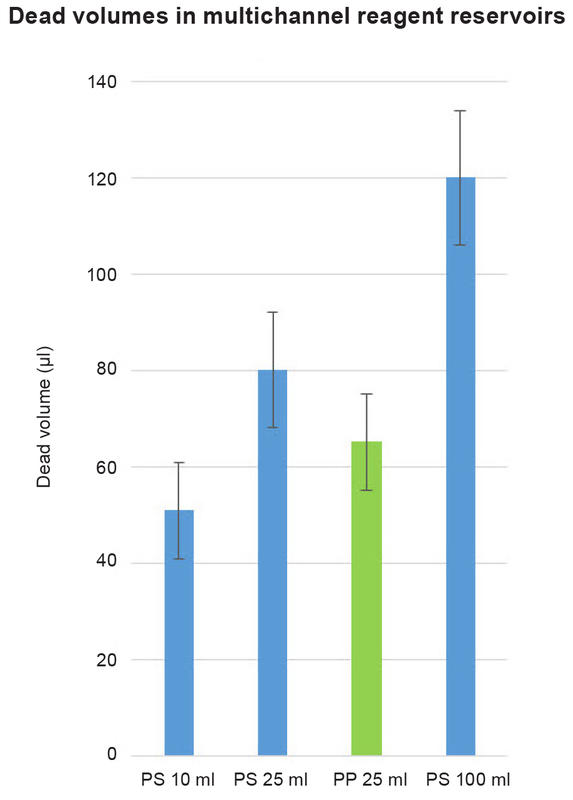
The majority of the buffer was aspirated using a VIAFLO 8 channel 1250 μl electronic pipette at speed 3. To determine the dead volume in the reservoir, we carefully aspirated the rest of the foaming buffer using a VOYAGER 12 channel 50 μl electronic pipette at speed 1 to ensure that no air entered the pipette tips. The tip spacing of the VOYAGER was set at 6.5 mm for the 10 ml reagent reservoirs and 9 mm for the 25 and 100 ml reservoirs. Results of the experiments are presented in Table 1 and Figure 2.
Large reagent reservoirs (25 and 100 ml) show low dead volumes of less than 1 % of the initial volume, while 10 ml reservoirs display a dead volume of 51 ±10 μl, representing 1.4 % of the initial volume.
Divided reagent reservoirs
In a second series of tests, we measured the dead volumes of new polystyrene and polypropylene 25 ml divided reservoirs in both the 5 ml and 10 ml compartments.
Tests were performed under the same conditions as those previously described using the blocking solution, and water ISO 3696:1995, grade 3, a 10 % Tween 20 solution in grade 3 water and an 80 % isopropanol (iPrOH) solution in grade 3 water. The aim of testing different solutions was to evaluate the influence of the liquid type on dead volumes, to provide more detailed insights.
Results were obtained by differential weighing of the reagent reservoirs using an analytical balance in the controlled environment of a calibration laboratory. Each measurement was repeated 10 times per reagent reservoir type to ensure result consistency.
For each reservoir size, we filled in the reservoir with an initial volume corresponding to 36 % of the nominal volume of the reservoir – a number easily divisible by the 8 and 12 channels of a multichannel pipette. Tips were pre-wetted three times to optimize pipetting performance and results.
To provide users with an ideal solution for small quantities of precious or rare reagents, INTEGRA designed 25 ml divided reservoirs with a SureFlo anti-sealing array on the bottom, a unique surface treatment and two compartments of 5 and 10 ml.
The main part of the liquid was aspirated with a VOYAGER 4 channel 300 μl electronic pipette at speed 5 for the 5 ml compartment and a VIAFLO 8 channel 1250 μl electronic pipette at speed 3 for the 10 ml compartment.
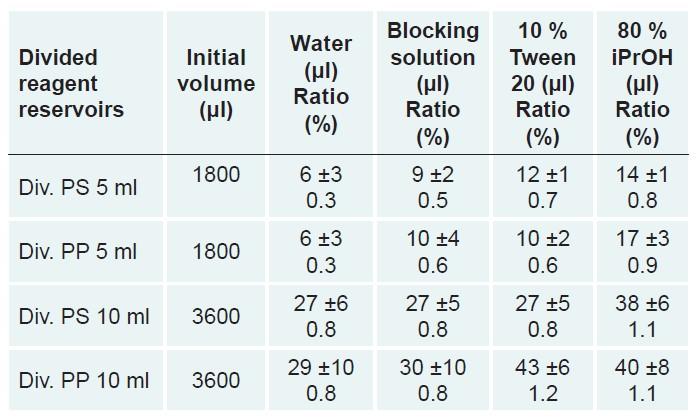
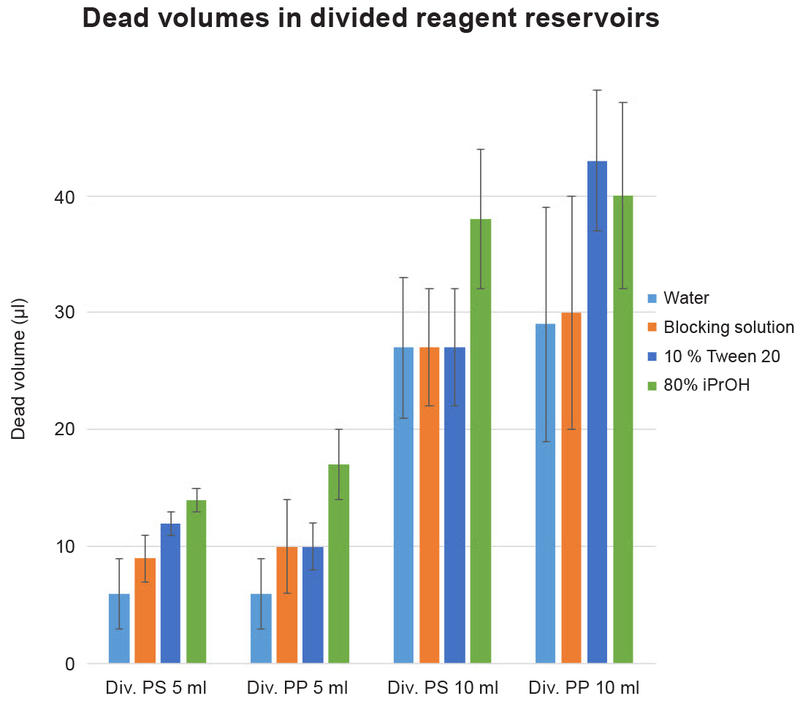
The remaining liquid was then carefully aspirated using a VOYAGER 8 channel 50 μl electronic pipette with 4.5 mm tip spacing for the 5 ml side and a VOYAGER 12 channel 50 μl electronic pipette with 6 mm tip spacing for the 10 ml side, at speed 1 to avoid any air entering the tips. The results of these tests are presented in Figure 3 and Table 2.
The results of this series of tests demonstrate the performance of the 25 ml divided reagent reservoirs from INTEGRA. The novel design of the 10 ml compartment reduces the dead volume of a foaming blocking solution from 51 ±10 μl to 27 ±5 μl while keeping the same working procedure.
For smaller quantities of the precious reagents, the 5 ml side of the divided reservoirs reduces dead volumes to around 10 μl, ~0.5 % of the initial volume in the reservoir.
Polypropylene divided reagent reservoirs present similar performance while offering an improved chemical compatibility in comparison with polystyrene.
Conclusion
Related articles
Further reading:
Ask our expert. Leave a comment!
Write us if you have any questions regarding the application note or one of our instruments.
Any questions? I'm happy to help!
Instruments and accessories
Divided Reagent Reservoir, Sterile, SureFlo anti-sealing array, 25 ml, PP
Lowest Dead Volume On The Market!
25 ml divided reservoirs are comprised of 5 and 10 ml compartments, while still nesting comfortably in the standard 25 ml reusable, sturdy base.
Each reservoir features the SureFlo™ anti-sealing array and hydrophilic surface treatment providing especially low dead volumes.
Part No. 4356 / 4357
Download
Application Note
DownloadMeasuring dead volume in INTEGRA’s multichannel reagent reservoirs
Customer’s voice
Awesome for molecular biology. The multichannel reagent reservoirs from INTEGRA are unique in their low residual volume. I would recommend them to anyone performing molecular biology protocols on a regular basis.